The 5-minute craft fair debrief: what to write down before you drive home

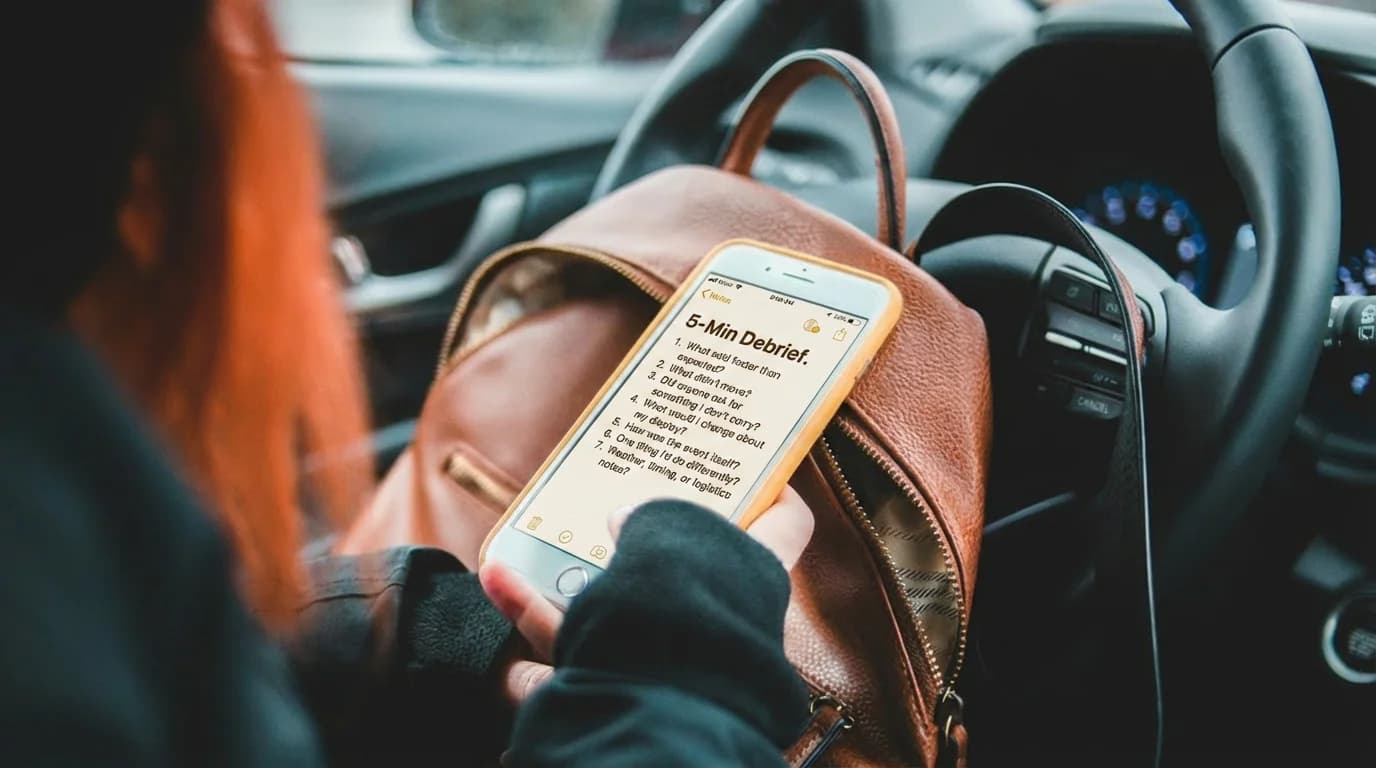
You just finished a six-hour craft fair. You're tired, your feet hurt, and you want to go home. The last thing on your mind is a "debrief."
But the things you noticed today will be gone by Tuesday. The product that flew off the table by 11am. The display change that didn't work. The customer who asked for something you don't make yet. The layout tweak you thought of during a slow stretch around 2pm.
Every vendor has had the experience of prepping for the next event and thinking "I know I meant to remember something from last time." That thought is a lost lesson. And lost lessons mean repeating the same mistakes, missing the same opportunities, and guessing when you could have known.
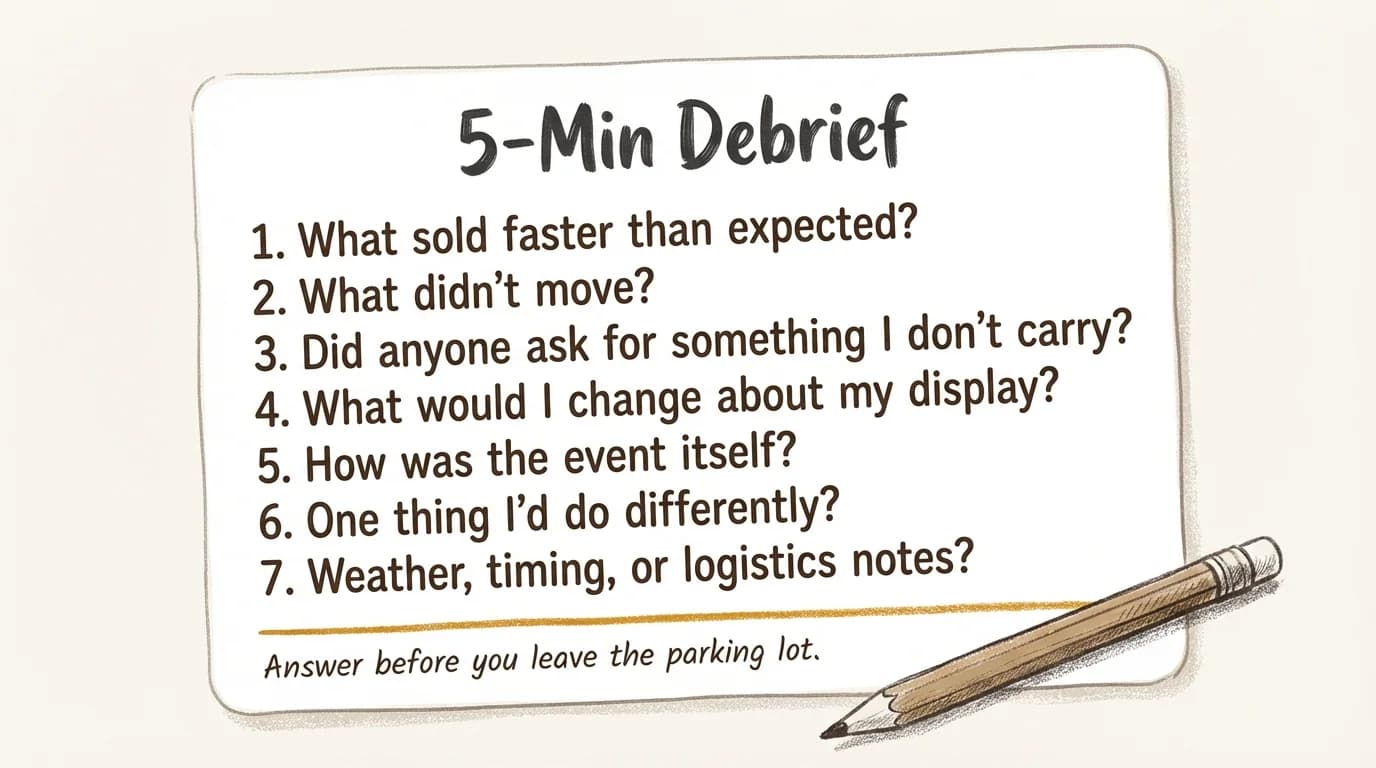
The fix isn't a detailed spreadsheet or a 30-minute review process. It's seven questions answered in five minutes, while you're still in the parking lot. Here's the template.
Why do craft fair lessons disappear so fast?
Because tired brains don't form durable memories. After six or more hours of selling, chatting, standing, and problem-solving, your working memory is full. The observations you made at 10am are overwritten by the decisions you made at 3pm. Without a prompt to capture them, the most useful insights from your day vanish within 24 to 48 hours.
This isn't a discipline problem. It's a biology problem. Your brain is prioritizing recovery, not record-keeping. That's why "I'll write it down when I get home" almost never works. By the time you've unloaded the car, eaten dinner, and sat down on the couch, the specifics are already fuzzy.
The solution is capturing notes before you shift out of event mode. Not after. Not tomorrow. Before you drive away.
The 5-minute post-event debrief template
Seven questions. One to two sentences each. Answer them honestly and move on.
1. What sold faster than expected?
This is your signal for what to make more of next time. Not just "candles sold well" but which candles. The small ones? The lavender scent? The ones on the front table? The more specific you are, the more useful this note becomes three months from now.
2. What didn't move?
Equally important. If something sat untouched all day, that's information. It might be the wrong product, the wrong price, or the wrong placement. You don't need to diagnose it right now. Just write it down so you can think about it later.
3. Did anyone ask for something I don't carry?
Customer requests are free market research. If three people ask whether you make gift sets and you don't, that's a product idea with built-in demand. If someone asks about custom orders, note it. These requests fade fast if you don't capture them.
4. What would I change about my display or layout?
Maybe the tall shelf blocked sightlines. Maybe the impulse items were too far from the register. Maybe your signage was hard to read from the aisle. One sentence about what you'd rearrange is enough.
5. How was the event itself?
Foot traffic, vibe, organization, parking, crowd energy. Would you do this event again? Was the booth fee justified by what you saw? This is the note that helps you decide whether to re-apply next year or skip it.
6. What's one thing I'd do differently next time?
Just one. Not a list of ten improvements. One concrete change. "Bring more small items under $15." "Set up the banner on the left side." "Pack lunch instead of buying it." Specific and actionable.
7. Any notes on weather, timing, or logistics?
Was it hotter than expected? Did the event start slow and pick up after noon? Was load-in chaotic? These context notes seem minor in the moment but become invaluable when you're preparing for the same event the following year.
That's the whole template. Seven questions, five minutes, done.
What should I write down after a craft show?
At minimum, capture three things: what sold well, what didn't sell, and one thing you'd change. Those three data points, attached to the specific event they came from, are more useful than any spreadsheet full of revenue totals. Revenue tells you how the day went. These three notes tell you why.
If you have another minute, add customer requests and an event quality rating. But the first three are the non-negotiable core. They're the difference between showing up to the next market with a plan and showing up with a guess.
The key is specificity. "Sales were good" doesn't help future-you. "Sold 18 of 24 small candles, ran out of lavender by 1pm" helps future-you a lot. You don't need to write paragraphs. You need to write details.
Where to capture your debrief (and where not to)
The best debrief tool is whatever you'll actually use at 4pm on a Saturday when you're running on coffee and adrenaline. Phone notes work. A notepad in the glovebox works. A voice memo on the drive home works. The back of your inventory sheet works.
What doesn't work: "I'll remember it." You won't. It feels like you will because the memories are vivid right now. They won't be vivid on Wednesday.
What also doesn't work: a complicated form that takes 20 minutes to fill out. If it feels like homework, you'll skip it the second you're tired. And you're always tired after a market.
The sweet spot is a tool that's fast, available, and attached to the event. If your debrief notes live in the same place as your packing checklist and your post-event restock routine, you'll actually find them when you need them. If they're scattered across three different phone apps and a crumpled napkin, they might as well not exist.
How do I use past event reviews to plan better?
Review your debrief notes the week before your next comparable event. Look for patterns across three or more shows: products that consistently sell fast (make more), products that consistently sit (make fewer or drop them), and recurring logistics issues (fix them permanently).
The patterns only appear if the notes exist. That's why the five-minute habit matters more than any individual review.
Say you've done five local craft fairs over the past year. You pull up your debrief notes and notice: small candles sell out at every single one, medium candles sell about half, and the large candles barely move. That pattern tells you exactly how to adjust your production plan. Make 50% more smalls, hold steady on mediums, and cut larges by half or drop them entirely.
Without the notes, you're working from memory. And memory will tell you "candles did well" without the detail that makes the insight actionable. If you're already using your Square sales data to see what sold, pairing it with your debrief notes adds the context Square can't capture: why it sold, what the crowd was like, and what you'd change.
This combination of numbers and notes is also what makes planning how many of each product to make feel less like guessing and more like deciding.
Turning debriefs into a planning system
The debrief is the input. The planning is the output. Here's how they connect:
Your "what sold" notes feed your inventory decisions. They tell you what to make more of, what to scale back, and what new products to consider based on customer requests.
Your "display and layout" notes feed your setup plan. Instead of rearranging your booth from scratch every time, you're iterating. Each event's layout is a refinement of the last one, not a restart.
Your "event quality" notes feed your event calendar. After a year of debriefs, you'll know exactly which shows are worth the booth fee and which ones aren't, based on your own data rather than someone else's review.
This is what we mean when we say your events should get smarter over time. Each show teaches you something. The debrief captures it. The next show benefits from it. The cycle compounds.
MyEventPrep is built around this cycle. Your event notes and checklists live next to your sales data and your packing checklist, so when you sit down to prep for the next market, everything you learned from the last one is already there. No digging through phone notes. No trying to remember which napkin you wrote on.
You don't need software to start this habit. The seven-question template above and five minutes of honesty will get you most of the way. But if you want the notes, the numbers, and the checklist in one place so the learning actually sticks, that's what the tool is for.
Five minutes now saves hours later
Three things to take with you:
- Capture your debrief before you leave the parking lot, not after you get home.
- At minimum, write down what sold, what didn't, and one thing you'd change.
- Review your past debriefs the week before your next event. The patterns are where the real value lives.
You don't need a perfect review process. You need a five-minute habit. Do it three times and you'll wonder how you ever prepped without it.
Start tracking your events in MyEventPrep free during early access. No credit card needed. See how it works on the homepage.
Frequently Asked Questions
When is the best time to review a craft fair?
Immediately after the event ends, before you drive home. Your observations are sharpest in the first 15 to 30 minutes after teardown. Even a five-minute review captured in the parking lot is more useful than a detailed one attempted two days later, because the specifics (which products moved, what customers asked about, how the layout felt) fade fast.
What stats should I track after a craft show?
Start with total revenue, number of transactions, and your best and worst selling items by quantity. If you know what you brought, calculate your sell-through rate (items sold divided by items brought). Over time, add average transaction value and revenue per hour. But honest qualitative notes about what you observed are often more actionable than the numbers alone.
How do I know if a craft fair is worth doing again?
Look at three things from your debrief: your revenue relative to the booth fee and your time, the quality of the foot traffic (were people browsing or buying?), and whether you enjoyed the event itself. A show can be financially solid but logistically miserable, or low-revenue but great for brand exposure. Your own notes over two or three years are the most reliable guide.
Should I use a spreadsheet or an app to track events?
Use whatever you'll actually fill out when you're tired. A simple phone note is better than a detailed spreadsheet you never open. If you want structure, start with the seven-question template in this post. If you outgrow that, a tool like MyEventPrep keeps your notes, sales data, and checklists together so you don't have to copy-paste between systems.
How many events before I start seeing patterns?
Three to five events of a similar type. Comparing a large outdoor summer market to a small indoor holiday pop-up won't reveal much. But three spring craft fairs of similar size will show you clear patterns: which products consistently sell, which don't, and what conditions affect your results. The more comparable the events, the faster the patterns emerge.