The complete craft fair packing checklist (so you never forget a thing)

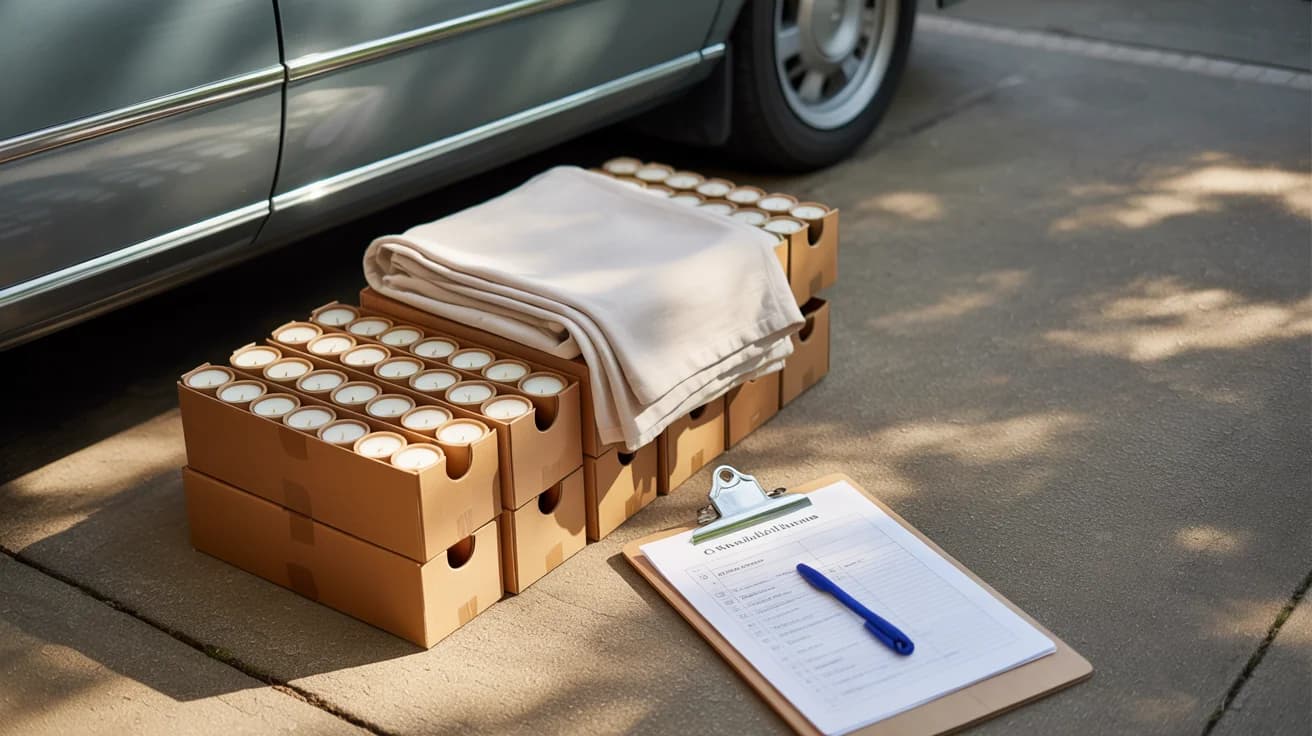
The worst feeling at a craft fair isn't slow sales. It's standing in your booth at 7:45am, fifteen minutes before the doors open, realizing you left something critical in the garage.
Every vendor has a story. Mine? I once showed up to a local craft fair without my tablecloths. Not "forgot to pack them" forgot. They were sitting folded on my kitchen counter. I spent the entire day selling off bare folding tables. Another time I brought tablecloths, but the wrong size, and ended up borrowing a mismatched one from the vendor next to me. Neither was a disaster, but both were the kind of thing that rattles you right when you need to feel settled.
This craft fair packing checklist exists so those moments stop happening. It's organized by category and roughly by packing order, so you can work through it start to finish the night before your event. Print it, screenshot it, or just bookmark it. Whatever keeps it within reach when you're loading the car.
In this guide:
- Booth structure and shelter
- What display items should I bring to a craft fair?
- Products, packaging, and inventory
- What payment tools do I need for a craft fair?
- The items vendors forget most often
- How should I pack for weather at an outdoor craft fair?
- The night-before packing routine
Booth structure and shelter
This is the big stuff. Pack it first because it goes in the car first (and comes out last at the venue).
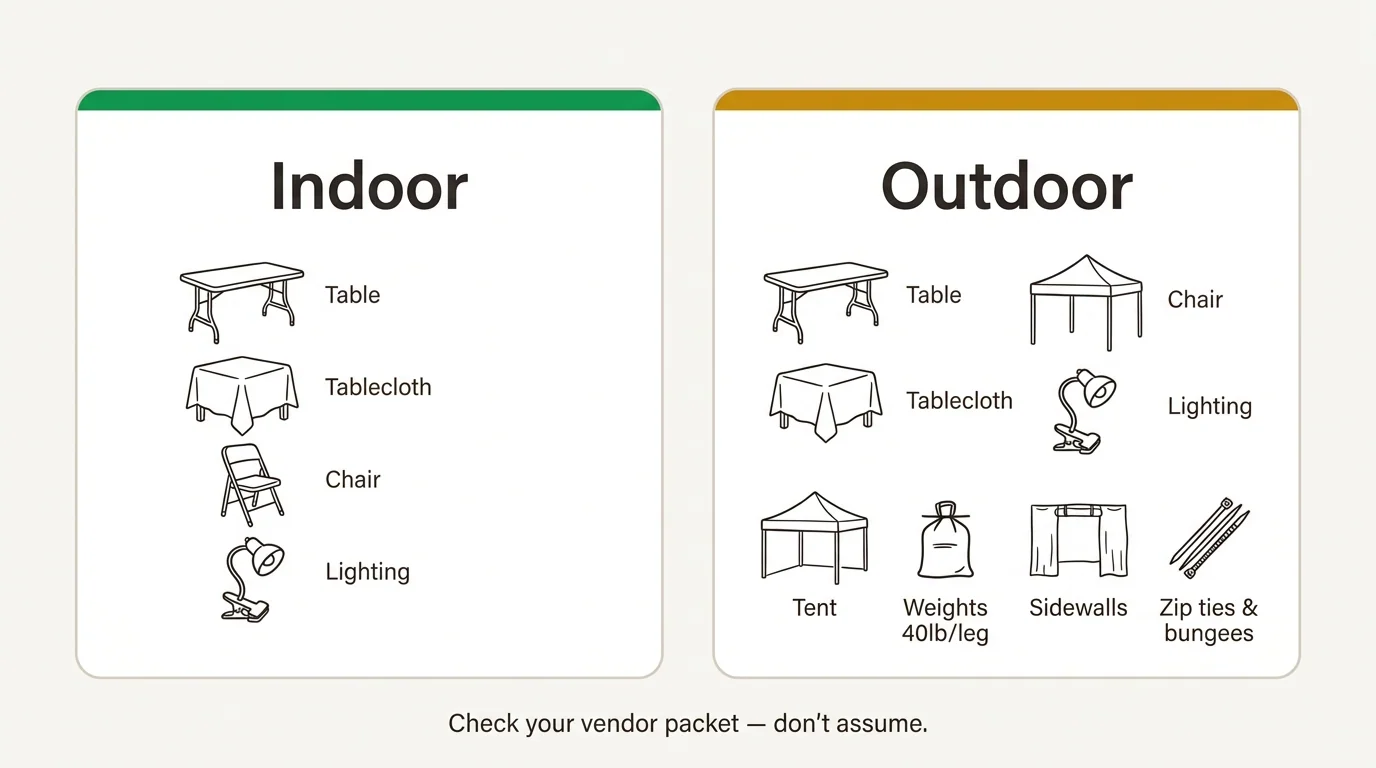
For outdoor events:
- Canopy or pop-up tent (10x10 is standard)
- Tent leg weights, at least 40 pounds per leg (sandbags, water weights, or concrete blocks)
- Tent sidewalls (at least two; more if rain is possible)
- Stakes and ropes (if the venue allows staking)
- Zip ties and bungee cords for securing fabric and signage to the frame
For all events:
- Folding tables (check how many your booth space fits; one or two is typical)
- Tablecloths sized to your tables (measure before you pack, trust me)
- Table clips or clamps to keep cloths from blowing or sliding
- At least one folding chair
If you're doing an indoor show, you can skip the tent and weights, but double-check whether the venue provides tables or whether you're bringing your own. Read the vendor packet carefully. Assumptions are where mistakes start.
What display items should I bring to a craft fair?
Bring everything that helps a customer understand your booth in under three seconds: who you are, what you sell, and how much it costs. That means shelves or risers for vertical display, clear price tags on every item, a sign with your business name, and a smaller sign showing which payment methods you accept.
Beyond the basics, your display kit depends on your products. But here's a good general list:
- Shelves, crates, or risers to add height (vertical displays outsell flat table setups)
- A branded banner or backdrop with your business name
- Individual price tags or a clear price sign grouped by product
- A "payment methods accepted" sign (cash, card, Venmo, etc.)
- Lighting (battery-powered LED strips or clip lights, especially for indoor venues with dim overhead lighting)
- A small mirror if you sell wearable items like jewelry or hats
- Easel or stand for any printed signage
Think of your display items as the frame around your products. The frame shouldn't steal attention, but without it, the products just sit there.
Products, packaging, and inventory
The obvious part first: bring your products. But the less obvious part matters just as much.
Products:
- Your full inventory, pre-counted and recorded (write down starting quantities before you leave)
- Extra stock stored in bins under the table to restock throughout the day
- A printed inventory list so you can track what sells
Recording your starting quantities is the step most vendors skip, and it's the one that makes the biggest difference for planning your next event. If you don't know what you brought, you can't calculate your sell-through rate later. Our post on figuring out how many of each product to make explains why that number matters so much.
Packaging for customers:
- Bags (paper, plastic, or branded tote bags)
- Tissue paper or bubble wrap for fragile items
- Boxes for larger or giftable items
- Stickers or labels if you use branded packaging
Backup supplies:
- Extra price tags and a marker (tags fall off, guaranteed)
- Scissors
- Tape (packing tape and painter's tape)
- A few rubber bands and clips
What payment tools do I need for a craft fair?
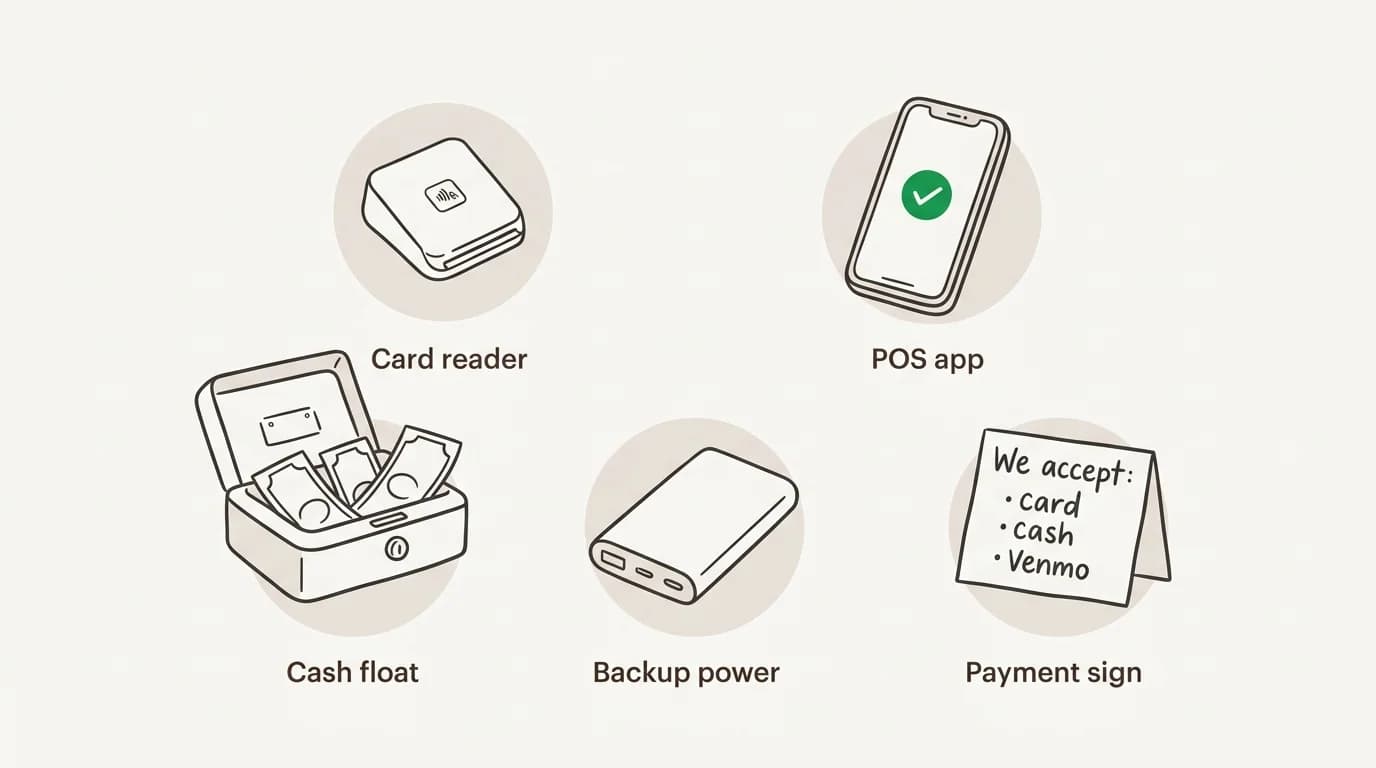
At minimum, you need four things: a card reader (Square, SumUp, or similar), your phone or tablet with the POS app installed and tested, a cash float of $75 to $100 in small bills and coins, and a backup battery pack or phone charger. Offering multiple payment options removes the most common reason a browser doesn't buy.
Here's the full payment kit:
- Card reader, fully charged
- Phone or tablet with POS app installed, logged in, and tested
- Cash box or cash pouch
- Cash float: roughly $50 in ones and fives, $25 to $50 in coins (quarters especially)
- Backup phone charger or battery pack (at least 10,000 mAh)
- Receipt book and pen (for cash sales if you want paper records)
- A sign listing your accepted payment methods
- Venmo, CashApp, or PayPal set up as a backup option
I learned this one the hard way. I left my Square Reader on my desk before a local craft fair and didn't realize until I was setting up. My partner was able to drive it over (thankfully it was a nearby event), but I lost a few sales in that first half hour with nothing but a cash box and an apologetic smile. Now the reader lives in my market bin, not on my desk.
If you're using Square, make sure stock tracking is turned on and your item catalog is up to date before the event. That way your Square data is actually useful when you plan your next market.
The items vendors forget most often
You'll remember the tent. You'll remember your products. You'll remember the card reader (hopefully). It's the small, unglamorous stuff that gets left behind.
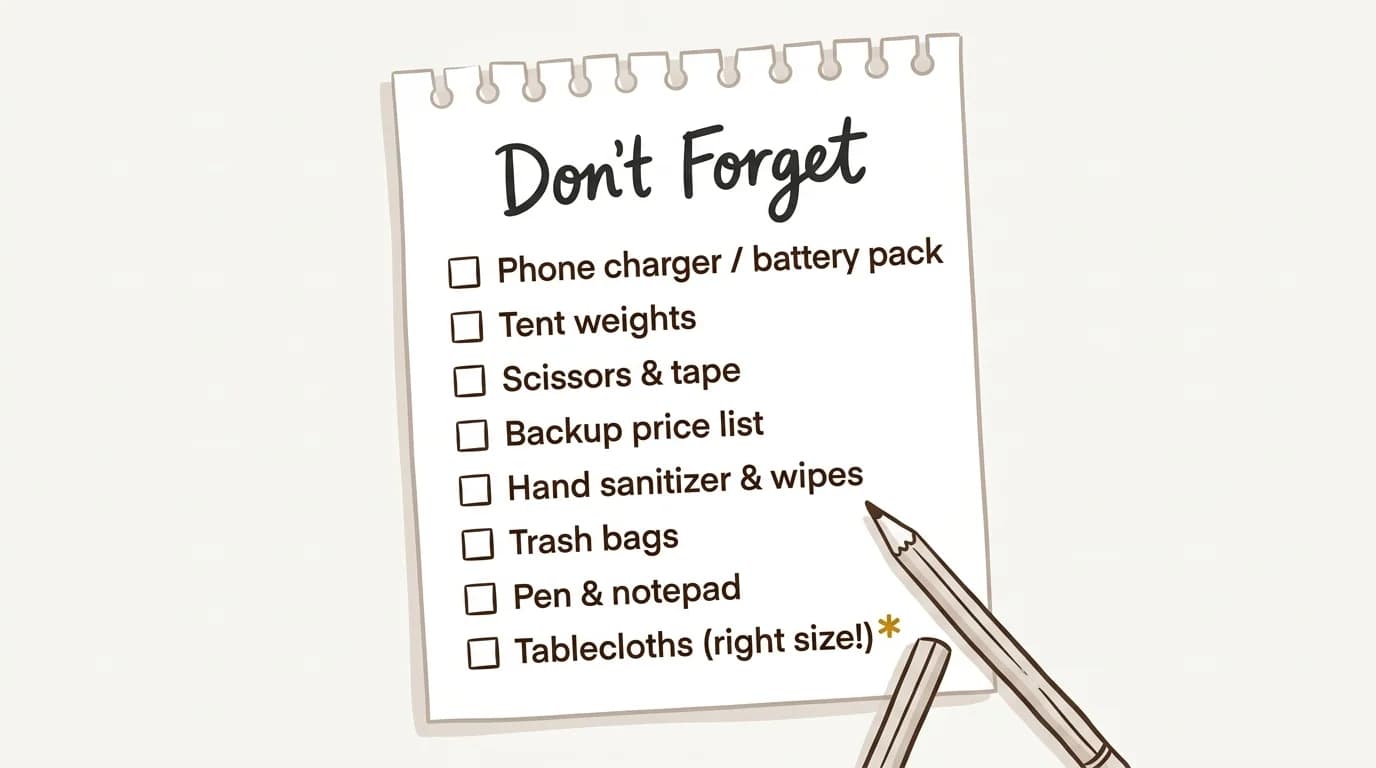
Here's the list, compiled from years of vendor forums and personal embarrassment:
- Phone charger or battery pack. Your phone is your POS, your calculator, your camera, and your clock. If it dies, your day gets hard fast.
- Tent weights. You packed the tent but not the weights. Now you're asking neighbors if anyone has an extra sandbag. (They don't.)
- Scissors and tape. You need them exactly when you don't have them.
- A price list or backup sheet. Tags fall off. Customers rearrange things. A printed reference sheet saves you from guessing your own prices.
- Hand sanitizer and wet wipes. Especially if you're handling food, cash, or anything customers will touch.
- Trash bags. Two or three large ones. For actual trash, but also as emergency rain covers for your table or bins.
- Pen and notepad. For writing down special orders, customer emails, or your own post-event notes.
- Tablecloths. Yes, really. They're easy to forget because they're not "product." But bare folding tables make your booth look unfinished. And make sure they're the right size for the tables you're bringing, or you'll end up borrowing a mismatched one from your neighbor (ask me how I know).
How should I pack for weather at an outdoor craft fair?
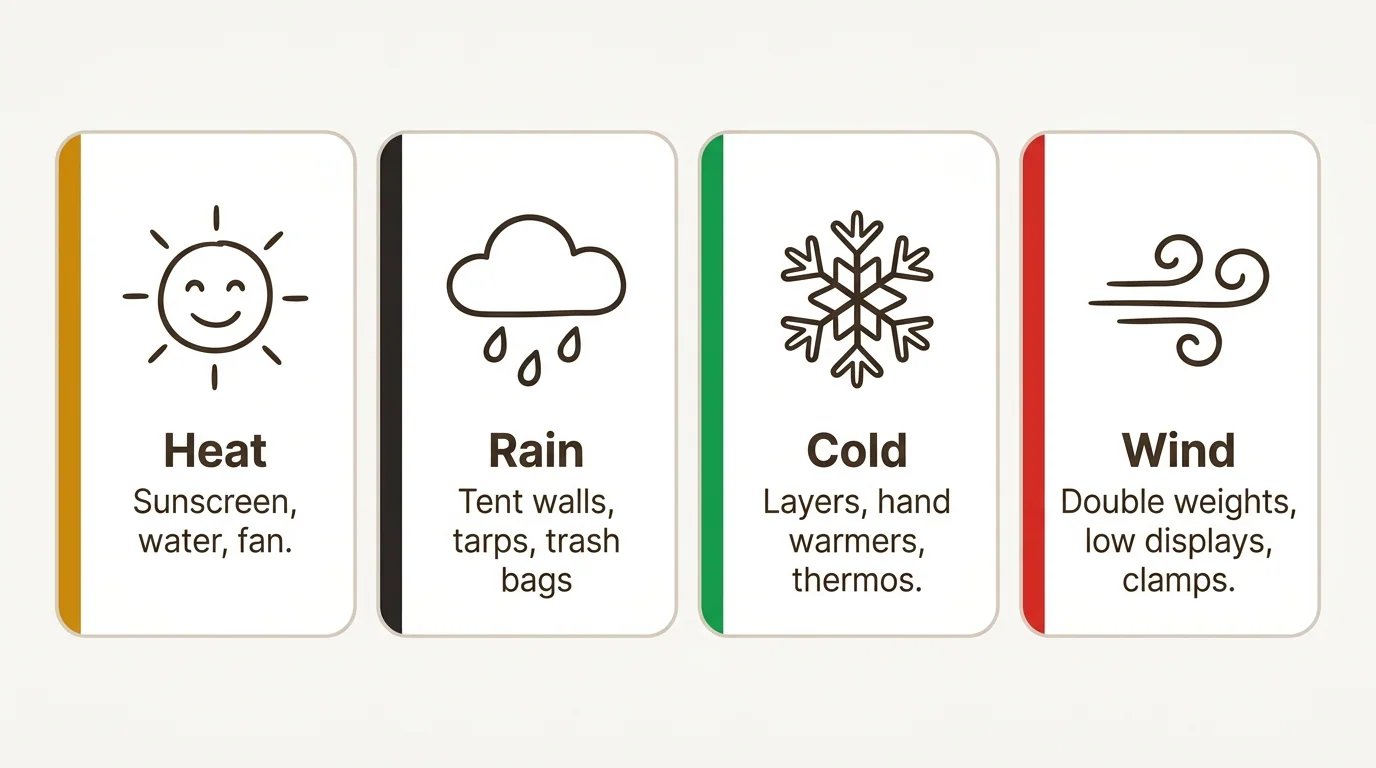
Pack for the weather you don't want, not the weather you expect. Sunscreen and water for heat. Tent walls and tarps for rain. Hand warmers and layers for cold. Extra weights and low-profile displays for wind. The weather that ruins your day is almost never the weather in the forecast. It's the surprise shift you didn't prep for.
Heat:
- Sunscreen and a hat
- A cooler with water and snacks
- A small fan (battery-powered clip fans work well)
- Wipes for keeping your display surfaces clean
Rain:
- Tent sidewalls (the single most useful rain defense)
- A tarp or plastic sheeting for extra coverage
- Large trash bags (for draping over bins or product in an emergency)
- Don't display all your inventory at once; keep backup stock protected under the table
Cold:
- Layers you can add or remove
- Hand warmers
- A thermos with something hot
- Fingerless gloves (you still need to handle products and money)
Wind:
- Extra tent weights (double what you think you need)
- Low-profile display items; tall lightweight signs become sails
- Clips and clamps to secure tablecloths, signage, and light items
- Rearrange displays so wind flows through your booth instead of catching on flat surfaces
Check the forecast the night before. Then pack as if the forecast is wrong.
The night-before packing routine
The checklist gets you packed. But the routine is what makes it stick.
The night before every event, set aside 30 to 45 minutes. Work through this checklist category by category. As you load the car, pack in reverse unload order: the things you'll need first at the venue (tent, tables, tablecloths) go in last so they come out first.
Once the car is loaded, do a quick five-minute scan:
- Are all devices charged? (Phone, tablet, card reader, battery pack)
- Is the cash box stocked?
- Did you check the weather one final time?
- Do you have your vendor packet or confirmation email accessible?
- Is your inventory list printed or saved on your phone?
This routine matters more than the checklist itself. The checklist tells you what to pack. The routine makes packing feel calm instead of frantic. And when you arrive at the venue settled instead of panicked, you set up better, you display better, and you sell better.
Over time, your checklist becomes personal. You'll add items specific to your products. You'll cross off things you never actually need. It stops being a generic list and starts being your system.
MyEventPrep keeps your checklist, event notes, and production plan in one place so nothing slips through the cracks. Each event you log makes the next one easier to prepare for. Start tracking in MyEventPrep free during early access, no credit card needed, and see how it works on the homepage.
You can also grab The Vendor's Calm Companion, a free guide to preparing for events without the overwhelm.
Frequently asked questions
What should I bring to a craft fair for the first time?
Focus on the essentials: your products, a table and tablecloth, a way to accept payments (card reader plus cash), price tags, bags for customers, and basic comfort items (water, snacks, sunscreen). Don't try to build a perfect booth on your first outing. Bring what you need, track what you wish you'd had, and improve from there.
How much cash should I bring for change at a craft show?
Start with $75 to $100 in small bills and coins. A good breakdown is about $30 in ones, $20 in fives, and $25 to $50 in quarters and other coins. You'll use less cash change than you expect if you accept cards and digital payments, but running out of change on a cash sale is a fast way to lose a customer.
Do I need a tent for an indoor craft fair?
Usually not. Most indoor venues provide a defined booth space with overhead lighting and climate control. Check your vendor packet to confirm whether tables are provided or if you need to bring your own. Some indoor events do allow backdrop structures or pipe-and-drape setups, which can help define your space visually even without a tent.
How do I secure my tent at an outdoor market?
Use weights of at least 40 pounds per leg. Sandbags, water weights, and concrete blocks all work. Most outdoor markets don't allow stakes on paved surfaces, so weight-based anchoring is the standard. In windy conditions, double the weight per leg and add guy ropes if space allows. An unsecured tent is a safety hazard, and most event organizers will ask you to take it down if it's not properly weighted.
What's the best way to organize packing for a craft fair?
Keep a dedicated "market bin" that stays packed between events with your non-perishable supplies (tape, scissors, clips, charger, cash box, tent weights). Pack the night before the event and load the car in reverse unload order. Use a checklist you refine after each show. The goal is a system you trust, not a perfect memory.