How many of each product should I make for a craft fair?

It's the night before your next market. You're staring at your workshop, your bins, your half-finished inventory list, and a familiar question: is this enough? Is this too much?
Every craft vendor knows that feeling. And if you've searched for an answer, you've probably found a dozen formulas that all say something slightly different. Bring 10 times your booth fee. Bring 3 times your sales goal. Estimate 2% of foot traffic and multiply by your average price.
None of them are wrong. But none of them tell you how many candles, how many mugs, how many earrings to actually put in the bin.
That's the question this post answers. Not "how much inventory" in dollars, but how many of each thing to make, and in what mix. We'll walk through a calm, repeatable framework you can use whether it's your first market or your fiftieth.
In this guide:
- Why isn't there one simple formula for this?
- The three-step framework
- How do I figure out the right product mix for a craft fair?
- What if this is my first craft fair?
- How do I use past events to plan better quantities?
- The display buffer: why you always need more than you'll sell
- How can I stop guessing and make this easier over time?
- Start with a framework, not a formula
Why isn't there one simple formula for this?
The right quantity depends on your price points, your product mix, the size of the event, and your own past performance. No single formula can account for all of that. Generic rules like "bring inventory worth 8 to 10 times your booth fee" are useful as guardrails, not gospel.
Think of it this way. A jeweler selling $12 earrings needs a very different quantity than a ceramicist selling $65 vases, even if they're at the same show with the same booth fee. The dollar target might be similar. The number of pieces is completely different.
That's why working from a framework is more reliable than plugging numbers into someone else's formula. The framework stays the same. The inputs change based on your products and your events.
The three-step framework
Here's the approach. It's three steps, and we'll walk through a worked example so you can see how the numbers shake out.
Step 1: Set a sales goal.
Pick a revenue number you'd be happy walking away with. If you're not sure, a common starting point is 4 to 5 times your total event cost (booth fee plus travel, food, supplies). If your booth fee is $150 and your other costs add up to another $100, a reasonable sales goal would be around $1,000 to $1,250.
Step 2: Map your product mix across price tiers.
Divide your products into three tiers: low (impulse buys), mid (your core sellers), and high (anchor pieces). Then decide how much of your sales goal each tier should carry. We'll cover the ideal split in the next section.
Step 3: Add a display buffer.
Take the quantity you calculated in step 2 and multiply by 1.5. This isn't wasted inventory. It's what keeps your booth looking full, inviting, and shoppable from open to close.
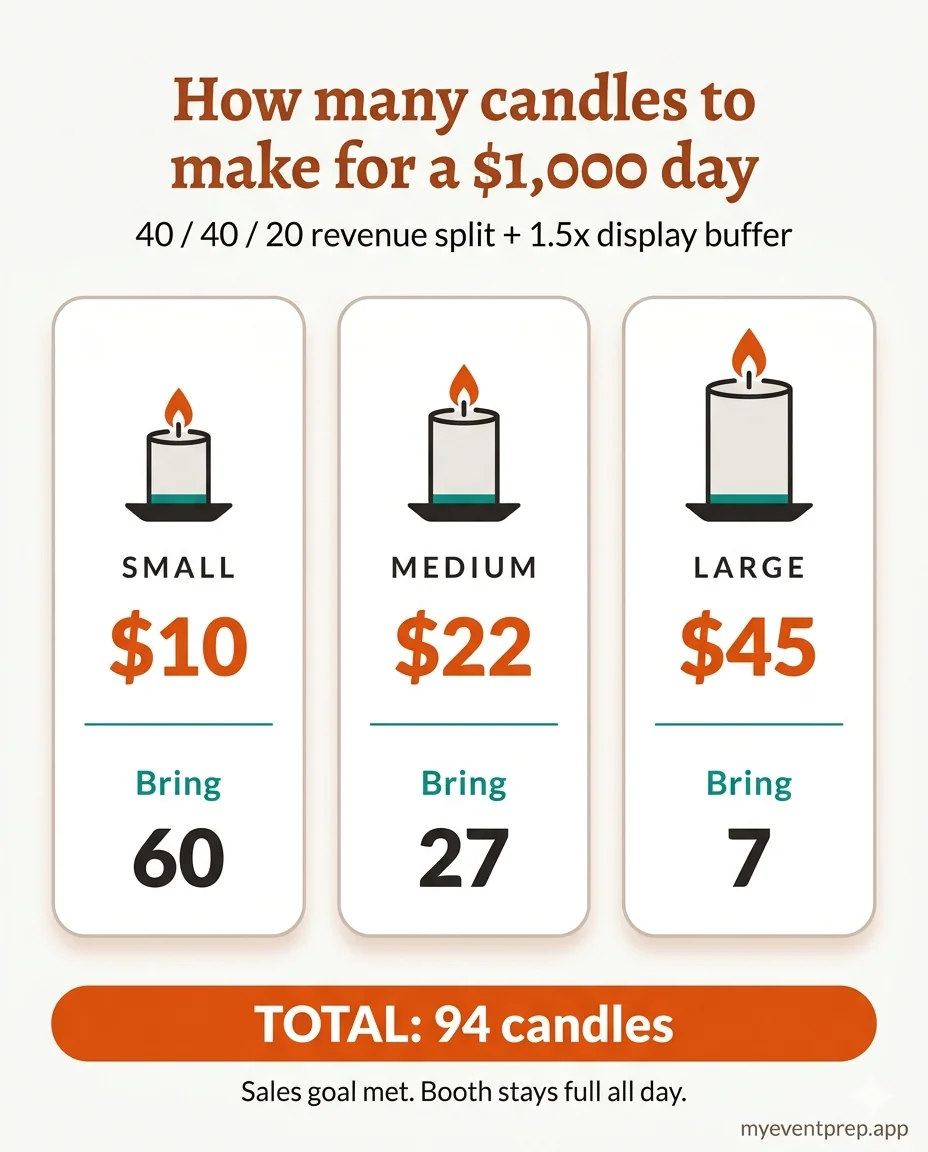
Worked example. Say your sales goal is $1,000 and you sell handmade candles at three price points: small ($10), medium ($22), and large ($45).
Using a 40/40/20 revenue split across tiers:
- Low tier ($10 smalls): $400 in sales = 40 candles sold. With the 1.5x buffer, bring 60.
- Mid tier ($22 mediums): $400 in sales = about 18 candles sold. With buffer, bring 27.
- High tier ($45 larges): $200 in sales = about 4-5 candles sold. With buffer, bring 7.
That's 94 total candles for a $1,000 day. Clear, specific, and plannable.
How do I figure out the right product mix for a craft fair?
Most successful craft fair booths follow a roughly 40/40/20 revenue split: 40% of your sales goal comes from low-priced impulse items (under $15), 40% from mid-priced core products ($15 to $40), and 20% from higher-priced anchor pieces ($40 and up). The exact thresholds depend on what you make, but the shape of the split holds across most product types.
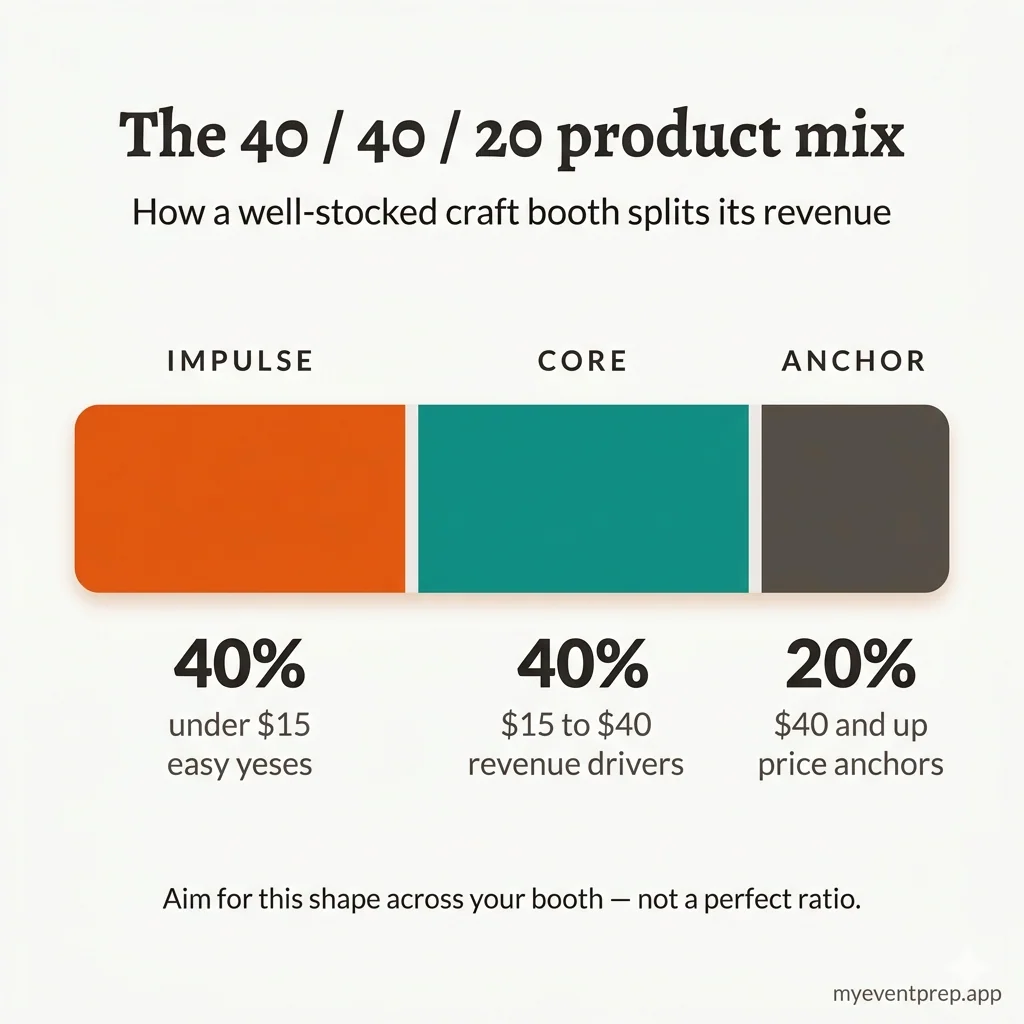
The low-priced items drive volume. They're what browsers pick up without thinking too hard. They keep the energy at your booth moving and they give hesitant shoppers an easy first purchase.
The mid-priced items drive revenue. These are the products most of your actual income comes from. They're intentional purchases, not impulse grabs.
The high-priced items do something subtler. They make everything else feel more affordable. A $65 vase on the top shelf makes the $22 mug next to it feel like a no-brainer. This is called price anchoring, and it works even if the expensive piece doesn't sell often.
You don't need to hit this split perfectly. But if you notice that 90% of your booth is mid-priced with nothing under $20, you're probably leaving volume on the table. And if everything is under $15 with no anchor piece, your revenue per customer will stay low.
What if this is my first craft fair?
If you don't have past data, lean on two things: the booth-fee rule and a narrow product line.
For quantity, bring inventory worth 8 to 10 times your booth fee. If your fee is $75, aim for $600 to $750 in retail value across everything you pack. Use the three-tier framework above to decide what that looks like in actual pieces.
For variety, go narrower than you think. It's tempting to bring a little of everything for your first show, but too many product types creates problems. Your display looks scattered. Customers feel overwhelmed by choice. And you end up making three of ten things instead of fifteen of three things.
A strong first booth might have three to five product types with real depth in each one. Five styles of earrings with three to four pairs of each is better than fifteen styles with one pair of each. The booth looks intentional. The display stays full longer. And you learn something clear about what sells.
How do I use past events to plan better quantities?
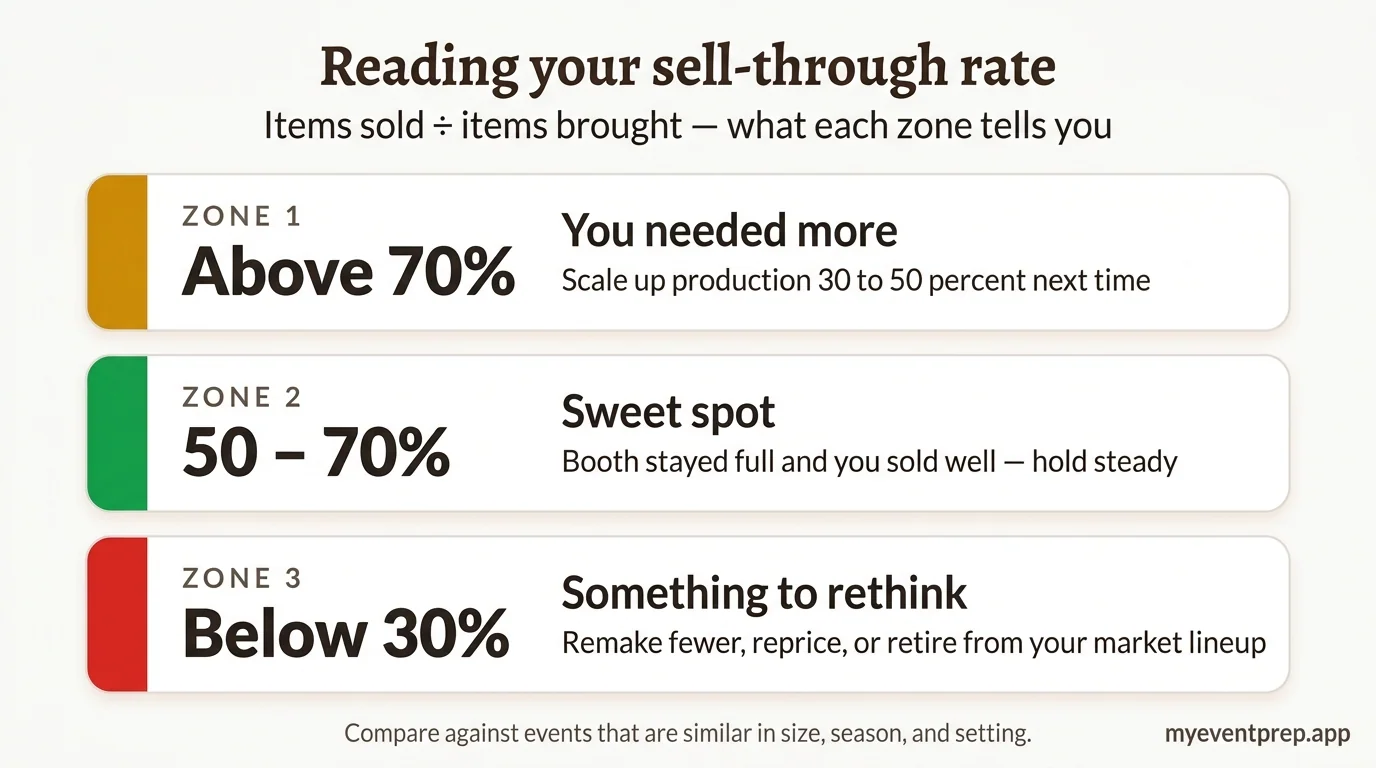
Pull your sell-through rate for each product from your last comparable event. The formula is simple: items sold divided by items brought. If you packed 30 small candles and sold 21, your sell-through rate was 70%.
That single number tells you what to adjust:
- Above 70%: You need more next time. You likely turned away sales when the display thinned out. Increase production by 30 to 50%.
- 50% to 70%: You're in the sweet spot. You sold well and your booth stayed full. Keep the same quantity or nudge it up slightly.
- Below 30%: Something needs to change. Either make fewer, reconsider the price, rethink the display, or retire the product from your market lineup.
The key word in this section is "comparable." A sunny June farmers market is not comparable to a rainy November pop-up. Match your past data to events that are similar in size, season, setting, and audience. If you don't have a comparable event yet, use the framework from step 2 and treat this show as the baseline for next time.
If you used Square at past events, your item sales reports already have the "sold" half of this equation. You just need to remember what you brought, which is the part most vendors forget to write down. Our post on using your Square data to plan your next market walks through how to pull those reports step by step.
The display buffer: why you always need more than you'll sell
Here's something that feels counterintuitive: as your inventory drops during the day, so do your sales. Not because demand disappears, but because a thinning booth looks like a closing booth. Browsers walk past. The energy shifts.
That's why the 1.5x buffer matters. It's not overproduction. It's part of the selling tool. A full, well-stocked display signals "this vendor is worth stopping at." A half-empty table signals "the good stuff is gone."
The buffer also gives you breathing room for a better-than-expected day. If the weather is perfect, the crowd is big, and your bestseller is flying, you don't want to run out by noon. The extra inventory lets you ride the momentum instead of watching it pass.
Think of the buffer as your display tax. You're not expecting to sell all of it. You're paying it forward in presentation.
How can I stop guessing and make this easier over time?
Capture three things after every event while it's fresh: what sold faster than expected, what didn't move, and one thing you'd change next time. Three sentences. That's all it takes. Even one event's worth of real notes beats any formula you'll find online.
The challenge is that this information tends to scatter. It ends up in phone notes, sticky pads, spreadsheets you never open again, or just your memory (which fades faster than you'd think). The vendors who plan calmly are the ones who keep everything in one place and review it right before they start making for the next event.
MyEventPrep is built for exactly this. It connects to your Square account, ties each sale to the specific event it happened at, and generates a production plan that tells you what to make, how many, and roughly how many hours it will take. Your post-event notes live right next to the numbers, so when you sit down to prep again, last-time-you is already there helping.
You don't have to track everything. You don't have to be perfect about it. Start with one event. Add what feels helpful. Each time you come back, the picture gets a little clearer.
Start with a framework, not a formula
Three things to take with you:
- Work backwards from a sales goal, not forwards from a vague sense of "enough."
- Split your products across price tiers (40/40/20) so your booth has impulse buys, core sellers, and an anchor piece.
- Multiply by 1.5 for the display buffer, and adjust based on real sell-through data as you collect it.
The goal isn't a perfect inventory count. It's showing up to each event a little calmer and a little more prepared than the last one.
If you'd like the quantity math done for you automatically, connect Square to MyEventPrep free during early access. No credit card needed. Start with one event and see how it feels. You can also grab The Vendor's Calm Companion, a free guide to preparing for events without the overwhelm.
Frequently asked questions
How much inventory should I bring to a craft fair?
A common starting point is to bring inventory worth 8 to 10 times your booth fee, and aim to sell about half of what you bring. For a $100 booth fee, that means $800 to $1,000 in retail value. Use your own past sell-through rates to refine that number after each event.
What's a good sell-through rate for a craft show?
Aim for 50% to 70% across your booth. If you're consistently selling out of an item (above 80%), you're probably under-producing or underpricing it. If something stays below 30% show after show, it's time to make less of it, reprice it, or rethink its place in your lineup.
Should I bring lots of variety or go deep on fewer products?
Go deeper on fewer products, especially for your first few shows. Three to five product types with real depth in each is stronger than ten product types with one or two of each. A focused booth looks more intentional, displays better, and gives you cleaner data on what actually sells.
What price points work best at craft fairs?
Most craft fair transactions happen under $50, driven by impulse buying. A strong booth has a range: low-priced items under $15 for easy yeses, mid-priced items from $15 to $40 as your core revenue drivers, and a few higher-priced pieces at $40 and up to anchor the display and make everything else feel more affordable.
How do I track what sold at a craft fair?
If you use Square, your item sales reports already log what sold and how many. The piece most vendors miss is tracking what they brought, which is what you need to calculate sell-through. Write down your starting quantities before the event opens, or snap a photo of your inventory list. MyEventPrep automates this by connecting to Square and tying sales to specific events.