What changes when you bring your Etsy prices to a craft fair


We've all set up a market booth with our Etsy prices printed on tiny tent cards. It works at first. Then you do a few events, look at the totals, and notice the math isn't quite what you expected. The booth fee ate a weekend. You ran out of one product and lugged 3 boxes of another home. And somehow the day didn't pay what an equivalent Etsy week would have.
Pricing Etsy items at a craft fair sounds like a copy-paste job. It isn't. The same product is selling in two different places, to two different versions of the same buyer, with different costs sitting behind each one. The number on the tag should reflect all of that.
Here's a calmer way to think about it.
Should you charge the same price at a craft fair as you do on Etsy?
Usually no. The platform fees you pay on Etsy and the costs you carry to a craft fair don't add up the same way, and the buyer standing in front of your table thinks differently than the one scrolling on their phone. The right booth price reflects both of those shifts, not just one.
For most makers, the booth price ends up close to the Etsy price, but the number gets there by a different path. That's the part worth getting right.
The costs change when you move from a screen to a table
Etsy's fees are well documented and easy to add up. You pay 6.5% on the transaction, 3% + $0.25 in payment processing, and $0.20 per listing. Add in shipping, supplies, and the occasional Offsite Ad cut, and most sellers see 20-25% of each sale go to Etsy once everything's counted.
At a craft fair, those fees disappear, replaced by:
- The booth fee. Smaller local shows run $25-$150 a day; larger festivals can hit several hundred to a few thousand.
- Card processing if you accept cards. Square and most competitors charge around 2.75% per swipe.
- Gas, tolls, packing materials, and the other costs that don't show up on the booth invoice.
- Your time setting up, sitting there, and tearing down.
The percentages can end up similar to Etsy's, just spread out differently. A $200 booth fee across 50 expected sales adds $4 to each item's true cost before you've sold anything. Before you set a single price, it's worth running the booth math: our free booth fee evaluator does it in 30 seconds.
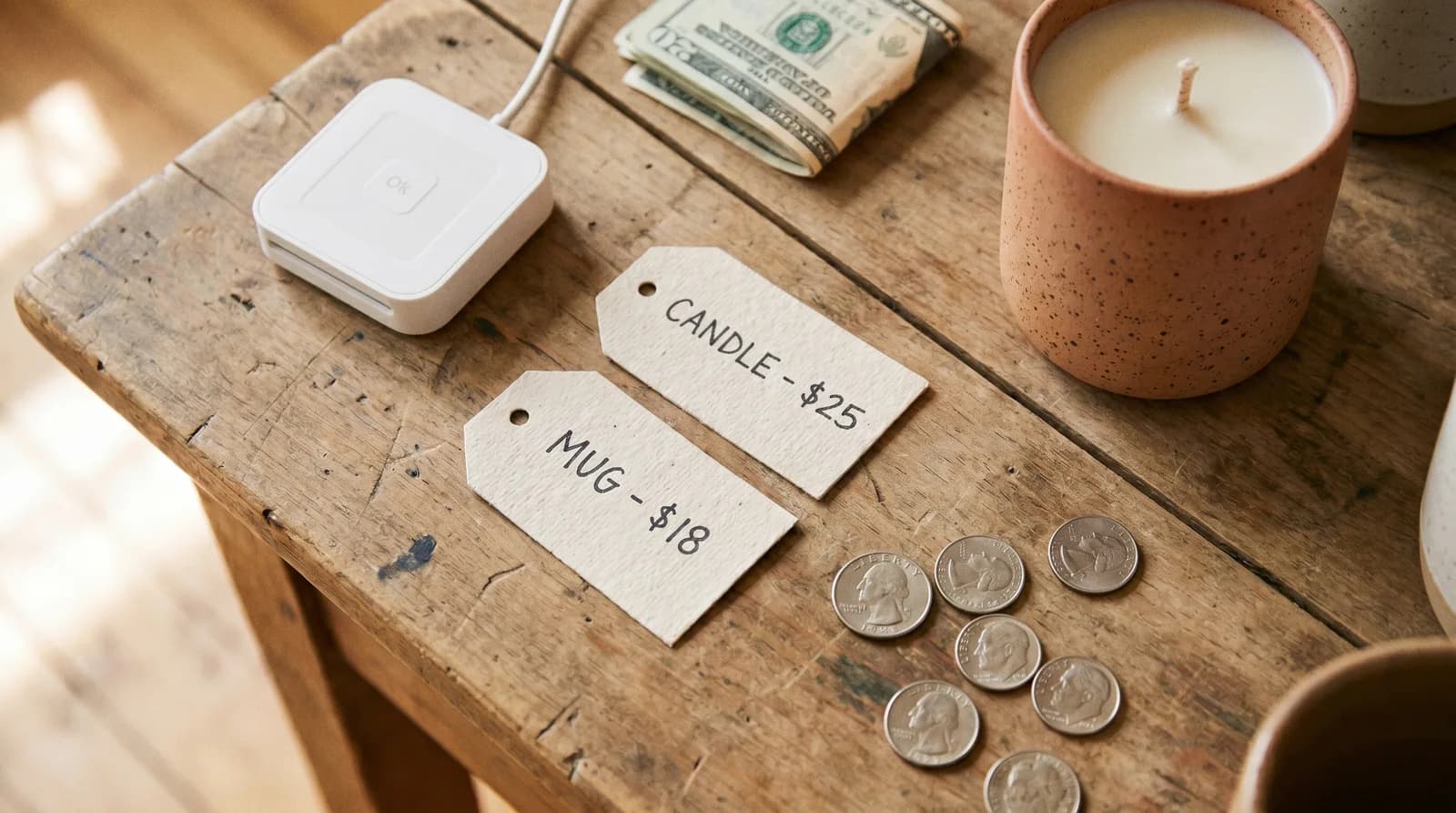
What makes someone buy at a market that doesn't happen on Etsy?
In-person buyers spend on impulse more often, decide faster, and respond to things a screen can't deliver. One study found 40% of in-person shoppers spend more than they planned, compared to 25% online. That's a wide gap, and it changes what your price tag is doing.
On Etsy, your price is competing against thousands of other listings in a grid. The shopper has time. They compare. They abandon cart. The lowest reasonable price often wins.
At a booth, your price is competing with what's already in the buyer's hand, the next booth over, and whether they want to keep walking. The smell of kettle corn matters. The sun matters. You picking up the piece and saying "I made this one last Tuesday" matters.
That gives you more room to move on price in person than you have online. Charm endings (the classic $X.99 trick) still work. So does anchor pricing: putting one higher-priced piece next to your main one changes how the main piece feels.
The "Etsy price minus fees" trap
Here's the move most makers make first. Etsy takes 20% of every sale, so at the booth, where there are no Etsy fees, drop the price 20%. Clean math, feels generous, draws a crowd.
The trap: that 20% wasn't free money. It paid for Etsy, but the booth needs the same thing. The fee just goes to a different recipient. If your $25 item works on Etsy at a 45% margin, dropping it to $20 at the booth (where you also need to cover the $200 day rate, gas, and your 12 hours of presence) will quietly underwater the day.
We learned this with our own work. We were making 3D-printed Pokemon Deck Boxes that priced fine on paper. They sat next to our other items at events, and the data from a few weekends told us the truth: they took hours to print, sold slowly, and their share of the booth fee meant they earned less per hour than almost anything else on the table. We dropped them. The pricing wasn't wrong on its own. The pricing once you counted the rest of the day was.
Your booth price isn't your Etsy price minus fees. It's a fresh calculation that starts from your true cost and accounts for what the booth itself charges, even when nobody invoices you for it. Most makers undercharge because they forget to count their own time. The booth is where that forgetting gets expensive fastest.
How do you actually set a booth price?
Start from your true cost (materials, labor, overhead), add your markup, then adjust the ending of the price to match how people pay at the event. Round numbers work for cash-heavy markets ($20, $25, $30 makes change easy). Charm endings ($14.99, $19.99) make prices feel lower when most buyers pay by card.

A standard handmade pricing formula is a fine starting point: (Materials × 2) + Labor + Overhead = wholesale, and wholesale × 2 = retail. From there:
- Add your booth cost per item. Divide the day's expenses by realistic expected sales.
- Bring an anchor piece. One higher-priced item, even if it rarely sells, makes the rest feel reasonable.
- Pick ending prices that fit the buyer. Round for cash, charm for card.
- Try a bundle. "2 for $30" is often a faster sell than two $18 stickers.
If math isn't your favorite part of this, the free profit calculator takes the inputs and shows per-product margin with the booth fee mixed in. Use whichever path is faster.
A note on margins: most handmade sellers aim for a 40-60% gross margin after everything. If a product can't hit that range at either price, the question isn't really pricing. It's whether the product earns its space on the table.
How do you know if it worked?
Track 3 numbers from each event and compare them to the same products on Etsy: revenue per hour, profit margin after booth costs, and sell-through (the percentage of what you brought that actually sold). If a product earns more per hour in person at the same margin, push more inventory there. If it doesn't, that's data, not failure.
A 5-minute post-event debrief does most of the work. The first time you do it, you'll spot patterns. The third or fourth time, the patterns turn into pricing decisions.
This is the part most makers skip. Setting prices is easy. Knowing whether the prices worked is what makes the next event better.
Wrap-up
The point of all of this isn't to add another spreadsheet to your life. It's to take one decision off your plate. Once you know your booth price isn't a copy of your Etsy price, you stop second-guessing it at every event. The number gets to be the number, because you set it for a real reason.
Try the free profit calculator to set your booth prices with the booth fee, your time, and your materials all in the mix. It takes a few minutes and replaces a lot of math you'd otherwise be doing on the back of a vendor agreement.
If you want the tracking handled too, so the "did it work" question isn't a notebook you forget in a bin, MyEventPrep does that part for you. Sign up free at myeventprep.app/signup and bring your numbers with you to the next market.
Frequently Asked Questions
Can I charge less at a craft fair than on Etsy because there are no platform fees?
Sometimes, but not by the full amount of the fees. Etsy's roughly 10-12% in platform costs go away at a booth, but the booth fee, gas, and your time replace them. A small price drop can make sense if the booth was cheap. Going below your Etsy price by more than 5-10% usually means you're paying the booth fee out of your own pocket.
Do I need to accept cards at a craft fair?
You'll lose sales without it. Many customers don't carry cash, especially for items over $20. Square and similar readers charge around 2.75% per swipe, which is well below Etsy's combined fees. Even when most buyers pay cash, having a visible card reader nudges the ones who came undecided.
Should I use charm pricing ($X.99) at craft fairs?
It depends on the event. Charm pricing makes prices feel lower when most people pay by card. At cash-only or older-skewing markets, round numbers ($20, $25) move faster because they make change simpler. Match the price ending to how people actually pay at the event.
How often should I revisit my pricing?
At least once a year, and any time material costs shift more than 5% or your time-per-item changes. Most makers wait too long and end up paying for inflation out of their own profit. A quick review after every 3-5 events catches this before it becomes a problem.
What if the fair is small and locals expect cheaper prices?
You can adjust what you bring without dropping your prices. Pack a few lower-priced items (smaller versions, simpler designs) alongside your usual stock so the booth has a more affordable option without devaluing your main work. The alternative, lowering your main product's price to match the market, sets a ceiling you'll have to climb back over later.