Pricing handmade products for your first craft fair

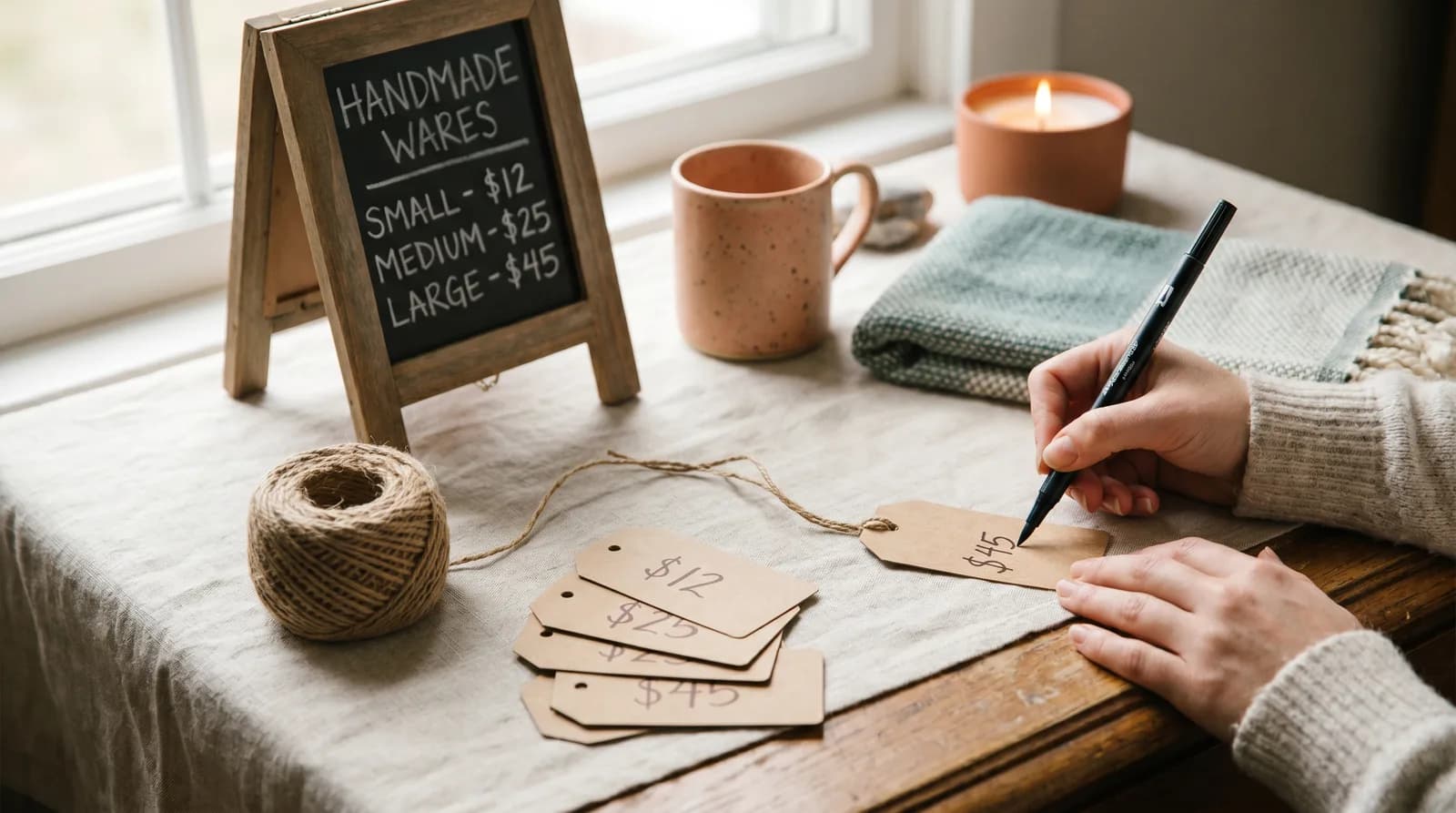
The night before a first market, pricing is usually the thing keeping a maker up. We've all stared at a row of finished products and a blank page, trying to decide what each one is "worth." The numbers feel arbitrary. They aren't, but they feel that way until you have a framework to lean on.
The good news: pricing for a craft fair is mostly arithmetic plus a few rules of thumb. Once you've done it for five or six products, the rest of your line falls into place. Here's the approach that tends to work for first-time vendors, with the parts new makers most often skip.
In this guide:
- Why does pricing for a craft fair feel so hard?
- The basic pricing equation (and what's hiding inside it)
- What's the right markup for handmade at a craft fair?
- Do I need to take cards at my first event?
- What price points actually move at a craft fair?
- How do I handle price tags on the day?
- A short week-of checklist
Why does pricing for a craft fair feel so hard?
Because there's no obvious anchor. Online, you have the platform telling you what similar items go for. At a craft fair, you're looking at one of your products, doing math in your head, and trying to guess what a stranger across a folding table will think is fair.
There's a second thing happening too. Most first-time vendors are pricing for the version of themselves who also makes the product, who knows how much effort went in, and who wouldn't dream of paying $40 for a candle. That version of you is the wrong customer. The right customer doesn't know the supply cost, doesn't know how long it took, and is buying the way it looks and feels on their kitchen counter, not the way it looked on your kitchen counter at midnight.
A framework helps because it stops the guessing. You're not deciding what each item is worth from scratch. You're plugging numbers into the same three boxes every time, and the price falls out.
The basic pricing equation (and what's hiding inside it)
Here's the equation almost every pricing post starts with:
(materials + labor) × markup = retail price
It's simple enough, but each of those three pieces hides a decision a lot of new vendors skip.
Materials. Count everything physical. Not just the obvious ingredients, but the small stuff that quietly adds up — thread, packaging, hangtags, the labels, the box. A useful trick: take your honest materials estimate, then add about 15%. You almost always miss something.
Labor. Count the hours you actually spent, including prep, cleanup, and the parts you don't enjoy. Pick a rate you'd be content earning per hour. There isn't a single "correct" rate — what matters is that it isn't zero. Most first-time vendors leave this out entirely, then discover after a long Saturday that they earned about $4 an hour for the whole project.
Markup. The multiplier that turns true cost into retail. Below 2x and there's barely any room to absorb a slow market or offer a small discount without losing money. Around 2.5x is where most handmade vendors end up landing once they've done a few events.
We cover what changes when those prices come from an Etsy shop in our piece on Etsy prices at a craft fair — the short version is the markup math holds, but the buyer behavior shifts.
What's the right markup for handmade at a craft fair?
A working answer:
| Markup | What it tends to feel like |
|---|---|
| 1.5x your true cost | You will probably lose money after the booth fee and prep day |
| 2x your true cost | The working floor — small profit, no room to run a sale |
| 2.5x your true cost | A more sustainable spot for most handmade lines |
| 3x and above | Possible at well-curated events or premium price points; uncommon for impulse items |
Markup isn't only about the math. It's also about whether the price gives you flexibility. At 2x, every $5 discount comes out of your own pocket. At 2.5x, you have a small cushion: room to offer a "two for $40" bundle, or to honor a friend's coupon, without taking the day to zero.
If your numbers are coming in below 2x and the price already feels uncomfortable, the issue is usually one of three things: undervalued labor, missed materials, or a product type that doesn't match this kind of event. We've all priced something into a corner and had to step back. It happens.
Do I need to take cards at my first event?
For most craft fairs, yes — and the math for why is straightforward.
| Cash only | Cards + cash |
|---|---|
| No processing fees | ~2.6% + 10¢ per transaction |
| Customers carry less, especially over $20 | No upper limit; impulse buys tend to be higher |
| You handle change all day | Square (or similar) handles totals and receipts |
| A meaningful share of sales walks away | You catch the cards-only crowd |
The fee on a $25 sale is about 75 cents. The cost of not being able to take that sale at all is $25. On anything above $10-15, the math tilts strongly toward accepting cards.
Bring cash for change anyway. A small float of fives and ones plus a roll of quarters covers most of what you'll see. Even at a card-heavy market, you'll handle a few cash transactions every couple of hours.
What price points actually move at a craft fair?
Round numbers do a lot of work at a booth. They make change simple, they read fast at three feet away, and they let a customer make a decision without doing math.
A starting cheat sheet for handmade goods:
- $5 / $10 / $15 / $20 — impulse buys, easy yes
- $25 / $35 / $45 — the "treat" range, where most steady sales happen
- $60 / $75 / $85 — gifts, especially in the fall and December markets
- $100+ — your anchor pieces
You don't have to twist your math to land on these. If your real number is $32, charge $32. Odd prices only feel odd in isolation — when everything on the table is priced consistently, customers don't notice. What hurts more is inconsistency: a row of products at $30, $35, $50, $52, $80 reads as random. A row at $30, $35, $50, $55, $80 reads as a price ladder.
How do I handle price tags on the day?
Tag everything, clearly, before you leave the house. A clearly priced booth lets customers shop on their own time. An untagged booth turns every sale into a small interaction the customer might not want to start.
A few practical things that tend to help:
- One consistent tag style across all products. Mixed handwritten and printed tags look chaotic and read as "not finalized."
- Tags or a small sign near each price tier, not on every single item, if you're selling many similar pieces (a row of $8 cards, a shelf of $20 mugs).
- Big enough to read from a step back. A tag that needs to be picked up to read is a tag a customer won't pick up.
- A "we accept cards" sign somewhere visible, even if it feels obvious — it isn't obvious to the half of customers used to cash-only booths.
For the events where the math feels especially close — short events, smaller crowds, longer drives — running the numbers through the Booth Fee Evaluator is a good gut check. It factors in your pricing, prep hours, and travel so you know going in whether a slow day still pays.
A short week-of checklist
Nothing fancy. Just the things that, done in this order, take pricing off the worry list for the night before:
- Pick five core products. Run materials + labor through the formula and apply your markup. Round to a comfortable nearby price point.
- Apply the same math to the rest of your line. It goes faster the second time.
- Sort your prices into a tier — impulse, treat, gift, anchor. Note any gaps where adding a small piece would round out the ladder.
- Print tags. All of them. One style.
- Set your float and reader. Small bills, coins, card reader charged, "we accept cards" sign somewhere visible.
- Run the event through the Booth Fee Evaluator to know what a break-even day looks like.
That's the whole thing. The first market is rarely a perfect read on your prices — the venue, the weather, the booth placement all bend the result. What it gives you is a baseline: real numbers you can adjust from for the next one.
If keeping that record between events sounds useful, MyEventPrep holds your pricing, prep notes, and sales totals in one place so the next show starts with last show's lessons instead of a blank page. Sign up free at myeventprep.app/signup during early access.
Frequently Asked Questions
How do I price handmade items for a craft fair if I've never sold in person before?
Start with materials plus your hourly time, multiplied by 2 to 2.5 for craft fair sales. Then round to a familiar price point — $15, $25, $45 — that sits comfortably above your floor. The exact number matters less than having a price you can defend and a margin that survives the booth fee. After two or three events, your actual sell-through numbers tell you whether to nudge prices up or hold steady.
Should my craft fair prices be the same as my Etsy prices?
Usually no. Etsy fees take roughly 20-25% of every sale, and a booth has different costs (the booth fee, travel, your day). Most makers land within 5-15% of their Etsy price, sometimes higher when the in-person experience adds value. We walk through the full math in our piece on Etsy prices at a craft fair.
What markup is reasonable for handmade at a craft fair?
2x your true cost (materials plus labor) is the working floor for most makers. 2.5x is more sustainable once you account for the booth fee, prep time, and the days a market doesn't pay what you hoped. Below 2x and there's almost no room to absorb a slow event or run a small sale.
Do I need to take cards at my first craft fair?
For most events, yes. A card reader pays for itself the first time a customer reaches for one and you can say yes. Square and similar readers charge around 2.6% plus 10 cents per transaction, which is well below what you'd lose on a missed $30 sale. Bring cash for change anyway — small bills, a few rolls of coins.
How should I handle price tags at my first event?
Tag everything, clearly, before you leave the house. A customer who has to ask the price is a customer half-deciding to walk away. Use small, consistent tags or a visible price list near each product group. If your prices end in unusual numbers (like $32 or $47), tag them anyway — they only feel odd in isolation.