Craft Fair Vendor Insurance: What You Need (Without the Overwhelm)

Few things deflate the excitement of getting into a craft fair faster than reading the words "vendors must provide a certificate of insurance" in the acceptance email. If you've never bought craft fair vendor insurance before, that line can feel like a wall. Suddenly you're googling "do I need insurance to sell at craft fairs" at 11pm and getting twelve different answers.
Take a breath. This is one of those things that sounds complicated and turns out to be pretty manageable once someone explains it without the sales pitch.
We're not insurance agents, and nothing here is legal or insurance advice. Think of this as a friendly map of the landscape. We'll cover what vendor insurance actually is, why markets ask for it, what it tends to cost, and how to get it. Then you can make your own call, or ask a licensed provider the right questions. No alarm bells, no upselling. Just the basics.
Do you need insurance to sell at craft fairs?
In most places, vendor insurance isn't legally required to sell handmade goods, but individual craft fairs and venues often require it as a condition of booking your booth. So while no law forces you to buy it, you may not get a table without it. The requirement comes from the event, not the government.
This is the part that trips people up. There's a difference between "the law says I must" and "the market says I must to sell here." As CraftCover explains, public and product liability insurance generally isn't a legal requirement for crafters, but many fair organizers will want to see proof of a policy before they let you set up.
So the honest answer to "do I need it" is: it depends on the events you want to do. Some small church bazaars won't ask. Larger juried shows, farmers markets, and festivals usually will. When you're evaluating which craft fairs to apply to, the insurance requirement is worth checking early, right alongside the booth fee and the dates.
What is general liability vs product liability?
General liability insurance covers injuries or property damage that happen because of your booth or your presence at an event, like a customer tripping on your tent leg. Product liability insurance covers harm caused by the item you made and sold, like a candle that damages a table. Many crafters carry both, often bundled together.
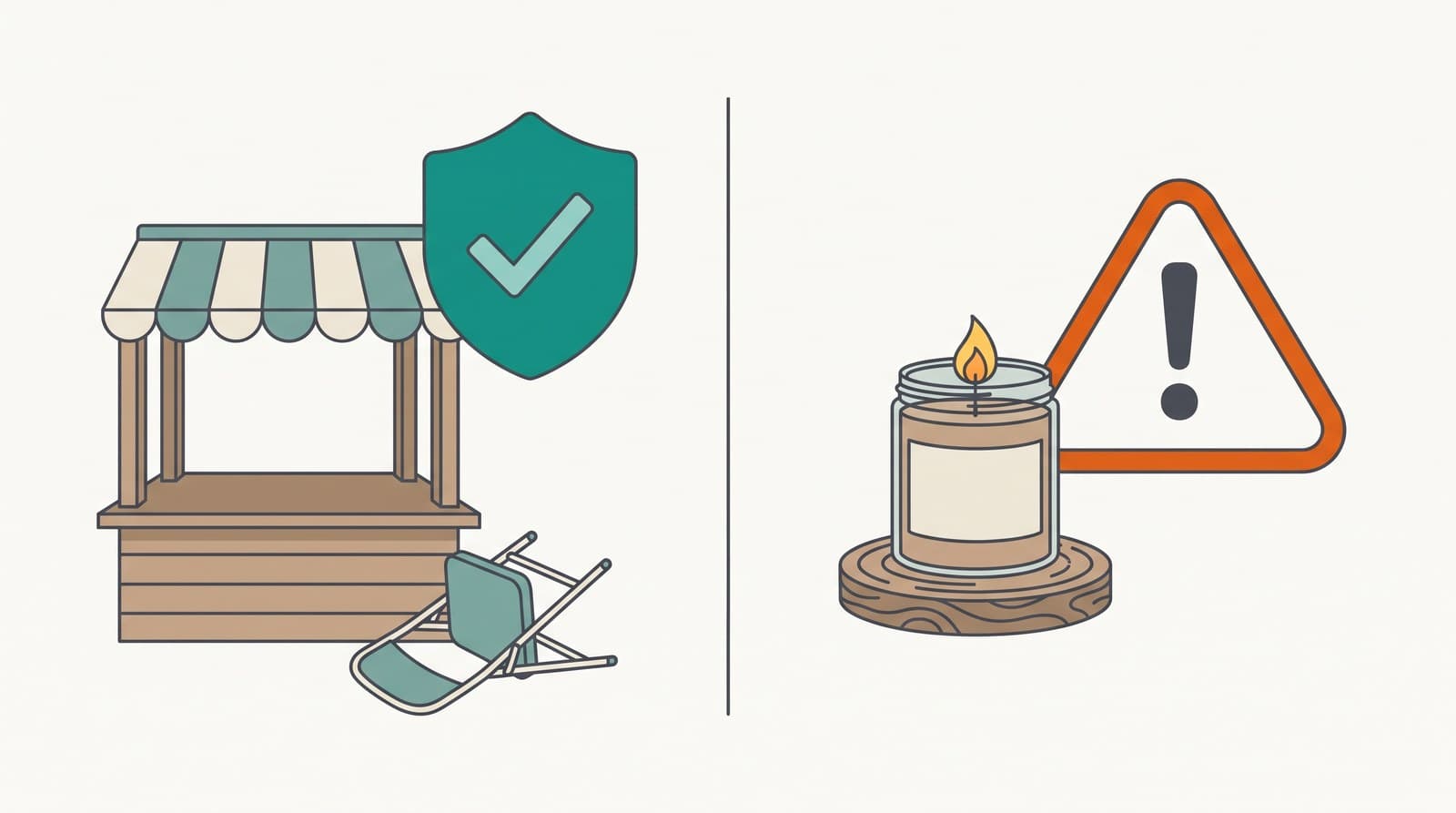
The easiest way to keep them straight is to think about where the problem happens.
- General liability. This is about the physical space and your activity at the event. The Hartford describes it as covering injuries and damage tied to running your booth, like someone tripping over a display or a gust knocking your signage into a neighbor's table.
- Product liability. This is about the thing you sell after it leaves your hands. If your lip balm causes a reaction or your wooden toy splinters, this is the coverage that responds. It follows the product, not the booth.
Here's the good news for makers: many crafter-focused policies fold both into one plan. Insurance Canopy's annual crafter plan, for example, includes general and product liability together rather than selling them separately. So "do I need two policies" usually turns into "one policy that does both."
You don't need to memorize the legal definitions. You just need to know that one covers your booth and one covers your products, and most maker plans handle both.
Why do markets ask for a COI?
A certificate of insurance (COI) is a one-page document that proves you have an active policy, listing your coverage limits and dates. Markets ask for it so they have written proof you're covered, and they often want to be named as an "additional insured" so your policy helps protect them too if something goes wrong at your booth.

The COI itself isn't the insurance. It's the receipt. Insurance Canopy compares a COI to an ID card for your policy: it carries your name, your coverage amounts, an expiration date, and a policy number. The event organizer keeps it on file.
The "additional insured" part sounds technical, but it's simple. It means the market or venue gets added to your policy so they're also protected if a claim comes from your booth. Event organizers for fairs, festivals, and markets commonly require this, usually asking for $1 million per occurrence and $2 million aggregate in general liability with the event named on the certificate.
A few things worth knowing so the request doesn't catch you off guard:
- The limits are pretty standard. That $1M / $2M figure shows up over and over. It's the default most markets ask for, so most maker policies are built around it.
- Adding the venue is usually free. Many providers let you add unlimited additional insureds at no extra cost, right from your online dashboard.
- They'll want it before setup. Build a little lead time in. Don't leave the COI for the morning of.
If you keep a packing and paperwork checklist for events, your COI belongs on it, right next to your permits and your float of small bills.
How much does vendor insurance cost?
Vendor insurance for craft fairs typically costs around $49 for a single event or roughly $265 to $400 per year for an annual policy that covers unlimited shows. Per-event coverage suits occasional sellers, while annual plans tend to pay off once you're doing more than a handful of markets a year.
The pricing is more reasonable than most makers expect. Here's a rough snapshot of what providers advertise. These are starting figures, not quotes, and your real number depends on what you make and how much you sell.
| Coverage type | Rough starting cost | Best for |
|---|---|---|
| Single event | ~$49 per event | Occasional or first-time vendors |
| Monthly | ~$24 to $45 per month | Regular sellers wanting flexibility |
| Annual | ~$265 to $400 per year | Frequent vendors doing many shows |
A few real numbers behind that table:
- Per event. Insurance Canopy's standard vendor policy starts at $49 per event and often includes a couple of extra days for setup and teardown.
- Annual. ACT Insurance lists a 365-day policy starting around $265, and Insurance Canopy's annual plan starts at $279 with both liability types included.
- Product liability on its own. ACT notes that product liability for artists and crafters typically runs $200 to $400 per year.
For broader context, small businesses across all industries pay an average of about $45 a month for general liability, and Insureon reports that 22% pay under $30. Crafters tend to land on the lower-risk end of that range.
The math often comes down to volume. If you do 2 markets a year, per-event coverage is hard to beat. If you do 10, an annual plan usually wins. This is the same kind of break-even thinking we use in the booth fee evaluator: add up the real cost, weigh it against the events you'll actually do, and pick the option that fits your year.
How do you actually get it
Getting covered is faster than most makers expect. Most maker-focused insurers run entirely online, and you can usually have a policy and a downloadable COI within minutes. You don't need an agent, a phone call, or a stack of paperwork.
Here's the general path, step by step:
- Check the requirement first. Read your acceptance email or the vendor application. Note the coverage limits the market wants (usually $1M / $2M) and whether they need to be added as an additional insured.
- Pick per-event or annual. Base this on how many shows you're doing this year. When in doubt, start with a single event and upgrade later.
- Get a quote from a maker-focused provider. Names that come up repeatedly for crafters include ACT Insurance, Insurance Canopy, Thimble, and NEXT. We're not endorsing any one of them, just pointing at where makers tend to look. Compare a couple.
- Add the venue as an additional insured. Enter the event's name and address so it appears on your COI. This is usually free.
- Download your COI and send it. Save a copy to your phone and email it to the organizer ahead of the deadline.
That's genuinely most of it. The biggest mistake is leaving it to the last minute, so give yourself a few days. A licensed provider can confirm the details for your specific situation, which is always worth doing before you buy.
Is it worth it for a small or occasional seller?
For occasional sellers, per-event insurance is usually worth it because the cost is low, the peace of mind is real, and many markets won't let you in without it. At roughly $49 a show, a single liability claim you'd otherwise pay out of pocket would dwarf years of premiums. For most hobby-scale vendors, it's a small, predictable line item.
We get the hesitation. When you're selling earrings for $15 and clearing maybe $200 on a good Saturday, every expense gets a hard look. That's healthy. It's the same instinct that keeps you from overpacking three wagonloads of product for a 4-hour event.
But insurance is one of those expenses that's small until the day it isn't. A customer trips on your tent stake. A market requires it and you can't apply without it. Suddenly $49 looks like a bargain.
A reasonable way to think about it:
- If you do 1 to 3 shows a year, per-event coverage keeps it cheap and you only pay when you sell.
- If a market requires it, the decision is made for you. Factor it into the booth fee math.
- If you're scaling up, an annual plan starts to make sense, and it covers online sales between events too.
Either way, treat it as part of the cost of doing business, the same as your booth fee or your pricing strategy. It's not a tax on your fun. It's the thing that lets you stop worrying and get back to making.
The calm takeaway
Craft fair vendor insurance is far less intimidating than that acceptance-email line makes it sound. Most markets ask for it even though no law requires it, the two common types (general and product liability) usually come bundled, and a COI is just proof you're covered. Costs are modest: around $49 per event or a few hundred dollars a year.
Decide based on how many shows you're doing, check each market's specific requirement, and give yourself a few days to sort the paperwork. Then let it go and focus on the part you actually love.
Once your coverage is handled, the next question is the fun one: what to actually bring. MyEventPrep helps you plan production, track what sells, and pack smarter so you're not hauling stock that never moves. Sign up free at myeventprep.app/signup and make your next event a little calmer.
This article is general information, not legal or insurance advice. Coverage, requirements, and costs vary, so confirm the specifics with a licensed insurance provider before you buy.
Frequently Asked Questions
Is insurance legally required to sell at craft fairs?
In most cases, no. There's usually no law requiring vendor insurance to sell handmade goods. However, many craft fairs, festivals, and venues require it as a condition of booking a booth, so you may need it to participate even though no law mandates it. Check each event's vendor application to be sure.
What's the difference between general liability and product liability insurance?
General liability covers injuries or property damage tied to your booth and activity at an event, like a customer tripping over a display. Product liability covers harm caused by the items you make and sell after they leave your booth. Many crafter policies bundle both types together in a single plan.
What is a certificate of insurance (COI) and why do markets want one?
A COI is a one-page document proving you have an active insurance policy, showing your coverage limits and dates. Markets request it as proof of coverage and often ask to be named as an "additional insured" so your policy also helps protect the event if a claim arises from your booth. Many providers add the venue for free.
How much does craft fair vendor insurance cost?
Single-event coverage typically starts around $49, while annual policies that cover unlimited shows generally run about $265 to $400 per year. Per-event plans suit occasional sellers, and annual plans usually pay off once you're doing more than a handful of markets a year. Your exact cost depends on what you make and your sales volume.
Is vendor insurance worth it for someone who only does a few craft fairs a year?
For most occasional sellers, yes. Per-event coverage is inexpensive, gives you real peace of mind, and is often required to get into a market at all. At around $49 per show, the cost is small compared to paying for an accident or product claim yourself. Confirm the details with a licensed provider for your situation.