Craft Fair Booth Layout: How to Design a Setup That Actually Sells

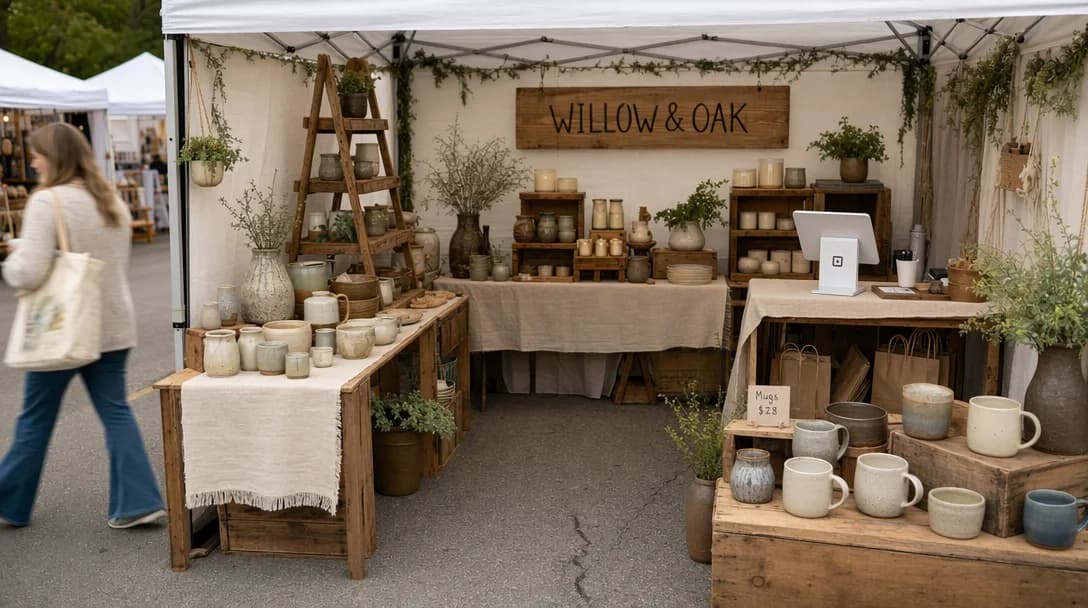
Most first-time vendors plan a booth the way you'd pack a car: how do I fit everything in? That question gets you set up, but it doesn't help anyone buy. The better question is the one retail stores answered fifty years ago: how do I move a stranger from the aisle to the register without making them feel herded?
A craft fair booth layout is a scaled-down version of that same problem. You've got 10 feet by 10 feet, a tent, and maybe six hours to earn back the booth fee. The layout (where the opening is, where the shelves go, where you stand) does more of the work than most of us give it credit for. This post walks through what actually moves sales, based on retail research and a few lessons we've learned the harder way than we'd like.
What Is a Craft Fair Booth Layout and Why Does It Matter?
A craft fair booth layout is the arrangement of your display tables, shelves, signage, checkout station, and customer walking space inside your booth's footprint (usually 10x10 feet). Layout matters because it decides whether browsers stop, step in, linger, and buy, or just keep walking. Shoppers form an opinion in the first couple of seconds, mostly on what they can see from the aisle.
The research here isn't new. Visual merchandising drives a real share of purchasing decisions once a shopper is inside, and the same forces apply inside a tent. Layout also connects to inventory: knowing which products actually sold at your last few events tells you what belongs at eye level and what belongs in the backstock bin. It also helps to know that most "booth layout ideas" content online is a Pinterest board: pretty pictures without a framework. That's what we're trying to fix here.
The Three Zones of a 10x10 Booth
Walk into any well-run retail store and you'll cross three zones in about fifteen feet: a transition area near the door, a main browse area, and a checkout. Your booth works the same way. The zones are smaller, but they're still there.
Entry / decompression zone (first 2 to 3 feet). Retail writer Paco Underhill named this the "transition zone" in Why We Buy. It's the first 5 to 15 feet inside a store, where shoppers adjust to the lighting, get their bearings, and decide if they want to stay. In a 10x10, this zone is compressed to about 2 to 3 feet. Don't crowd it. No checkout here, no hard-sell signage, nothing that demands a decision. The job is just to let someone in.
Browse zone (the middle 4 to 6 feet). This is where your products live. Eye-level merchandise, shelf risers, your bestsellers. More on this in a minute.
Transaction zone (back corner, 2 to 3 feet). This is your checkout: Square stand, bag storage, business cards, receipt printer. Tucked away on purpose.
The most common mistake we see (and have made ourselves) is putting the checkout in the entry zone, usually because the table with the cash box is the heaviest thing to move. That one choice turns your opening into a counter, and quietly kills half your foot traffic.
Traffic Flow: U-Shape, L-Shape, or Open-Front?
A booth's traffic flow is the path a customer's feet take once they step inside. The three common shapes are open-front (no internal tables, customers stand at the perimeter), U-shape (tables on three sides, with a bay in the middle), and L-shape (tables on two adjacent sides, usually for corner booths). Pick by product type and volume, not by what looks prettiest in a photo.
Open-front works best for high-volume, low-ticket items: stickers, prints, small jewelry. Customers don't need long with any one piece, and you want as many hands as possible on the product. The trade-off is less display surface and a booth that feels less like a little store. See our Open Front template for a 10x10 version drawn to scale.
U-shape is the workhorse for most craft vendors. A shopper walks in, is surrounded by product on three sides, and naturally pauses. It gives you a clear place to stand and chat without blocking anyone. A good rule of thumb is to avoid a center-aisle layout that leads to a back wall, which turns your booth into a dead end. The U avoids that by giving the eye something to land on in every direction. See our U-Shape template for a working 10x10 example.
L-shape is the corner-booth special. If the event gave you a corner, take it: you've got two open sides of aisle traffic. An L puts tables along your two closed sides and leaves both openings clear. Our L-Shape Corner template shows the standard arrangement.
Why Is Eye Level the Money Spot in a Craft Booth?
Eye level is the money spot because adult shoppers' gaze naturally lands in the 50-to-60-inch range when scanning a display, and that's the band where browsing decisions get made. Anything lower reads like a floor, and anything higher feels like ceiling space. Flat tables alone leave most of your selling real estate unused.
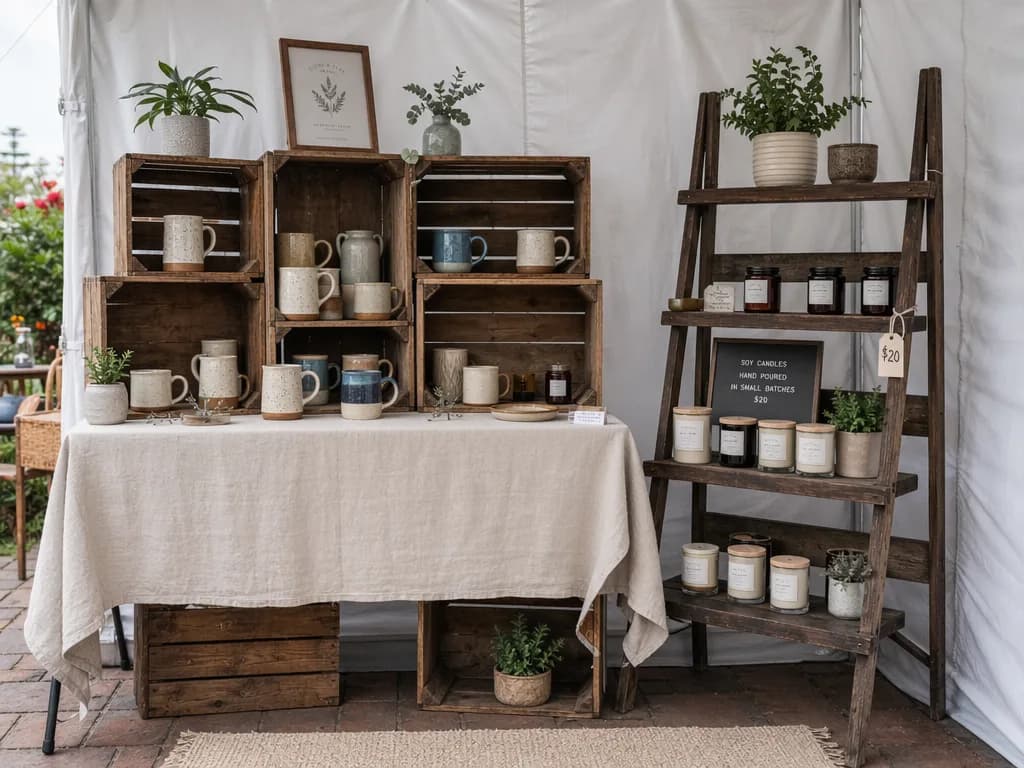
Retail display folks have a saying: eye level is buy level. It's a little corny, and also true. Eye level sits around 50 to 60 inches from the ground for most adults, and that's where a customer's gaze lands first. Put your most interesting (or most profitable) product there. Use shelf risers, crates, a back wall of gridwall panels, or even a ladder shelf if your pieces are light. Gridwall panels with T-leg bases can push your usable height up to 6 or 8 feet tall without anything mounted to the tent itself.
Two practical notes. First, leave breathing room. Vertical doesn't mean stuffed. A shelf jammed with product reads as clutter, which is the opposite of interesting. Second, anything below about 36 inches is basically a floor to most adults. Save that space for backstock bins, packaging, or oversized pieces that reward bending down.
Where Should Your Bestseller Go in a Craft Booth?
Your bestseller goes in the middle-back of the browse zone, at eye level, not at the front of the booth. Placing your hero product just past the entry makes browsers physically commit to stepping in before they can reach it. Front-loading the bestseller lets shoppers decide from the aisle, and most will keep walking.
This feels backwards the first time you hear it. You want people to see the best thing, so shouldn't the best thing be right up front? Sort of. They need to see it from outside the booth, yes, but the whole point of the layout is to get them inside. If a shopper can grab the good thing from the sidewalk, they've got no reason to step over the threshold and discover the other nine things they might like.
Treat your bestseller like a magnet, not a billboard. Visible from ten feet out (that's what height and lighting are for). Touchable only from inside.
The Checkout Station Belongs in the Back Corner
Your checkout is infrastructure, not merchandise. It shouldn't greet anyone, and it shouldn't sit between a customer and the product. Back corner is almost always the right answer.
A good back-corner setup has your Square stand, a small bag and tissue stash, a shallow tray for cards and receipts, and room for you to stand without bumping into shelves when you ring someone up. If you're already running Square, the sales data from each event feeds back into which products earned their shelf space and which quietly didn't. If you run a two-person booth, the second person works the entry as a greeter while checkout stays tucked away. If you're solo, plant yourself at checkout but step aside when someone walks in. The aisle inside your booth is for the customer, not for you.
A small tell that the checkout is in the wrong place: at the end of the day, is there a pile of customer stuff (coats, bags, half-wrapped items) buried on your display? If yes, the checkout was in someone's way.
How Should Booth Signage Be Readable at 20 Feet?
Booth signage should be built in three tiers, each readable at a different distance: a top-level business name or category visible from 20 feet, section signs visible from 10 feet, and price tags readable at arm's length. The rough math is 1 inch of letter height per 10 feet of viewing distance, so a business-name banner needs letters at least 2 inches tall, and 3 is better.
The rough rule of thumb in signage design is 1 inch of letter height per 10 feet of viewing distance, which is where the 2-inch minimum comes from.
In practice, most booths nail tier 1 (everyone buys a banner) and skip tier 2 entirely. Section signs are the easy win. A shopper who can see from the aisle that you sell "beeswax candles" or "hand-poured soaps" is already halfway to a decision. If they have to squint at a 12-point price tag to figure out what you make, they won't.
Keep font choices boring. Sans-serif, high contrast, few words. Craft is where cursive scripts go to die at a distance.
How Do You Test a Booth Layout Before the Event?
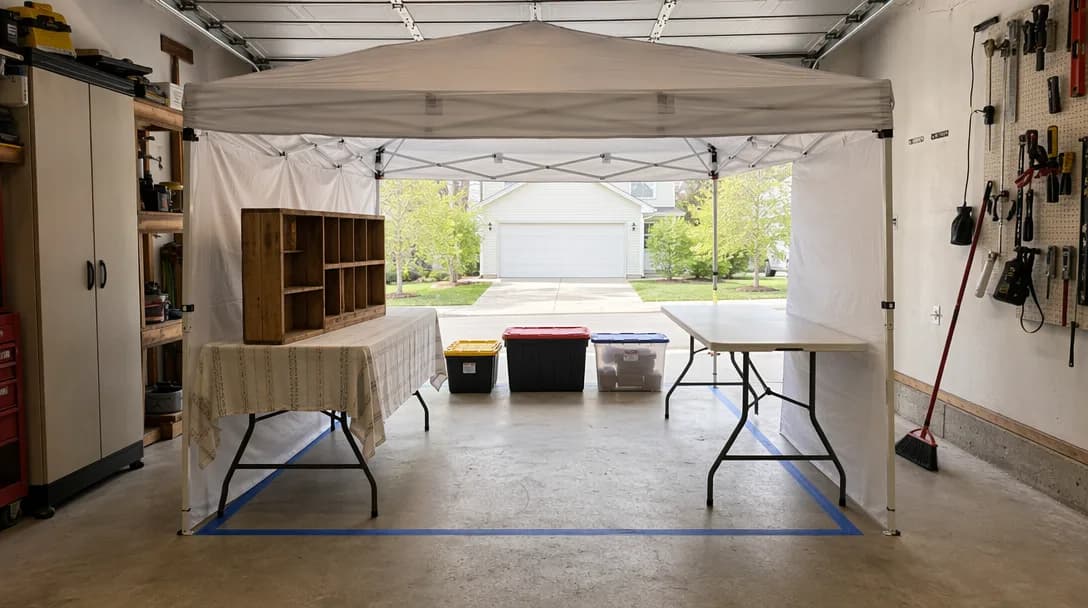
You test a booth layout by marking out a 10x10 square with painter's tape in your garage, driveway, or living room, setting up your tables and displays exactly as you plan to at the show, and walking through it from the aisle. Then photograph the booth at standing eye level from ten feet away. Most layout problems (checkout in the wrong place, empty back wall, overcrowded entry) are obvious in the photo and nearly invisible in your head.
This is the single highest-value thing you can do the week before an event. It takes an hour. It's also the exact thing almost no one does, because hauling the whole booth out for a dry run feels a little silly. Do it anyway.
If taping out a garage isn't an option, our Booth Layout Planner is a drag-and-drop version of the same exercise. You can start from one of our 10×10 or 10×20 templates or build from scratch with 134 preset items, then save the layout and pull it up again next event. It's not a replacement for walking the physical space once, but it's a much faster first pass, and the saved layouts carry forward with the rest of your event notes.
Pulling It All Together
A booth that sells isn't a puzzle you solve once. It's a layout you iterate on across a few events, keeping what works and quietly dropping what doesn't. The patterns are stable: three zones, a traffic path, vertical displays, checkout in the back, three tiers of signage. The specifics depend on what you make.
If you take one thing from this post, take the walk-through. Tape out a square, set up the booth, photograph it from the aisle, and look at what a customer would actually see. That's the whole game.
Ready to plan your next show? Save layouts and reuse them across events with a free MyEventPrep account. Every layout you build becomes a starting point for the next one.
Frequently asked questions
How big is a standard craft fair booth?
The most common craft fair booth size is 10 feet by 10 feet (10x10), which fits a standard pop-up canopy. Some events offer 10x20 double booths or smaller 8x8 spaces. Always check the application or event packet for exact dimensions and any rules about tent lines, fire lanes, or shared walls.
Where should the checkout go in a 10x10 booth?
Put the checkout in a back corner of the booth, not at the front or center. A back-corner checkout keeps the entry zone clear, gives you a place to ring sales without blocking traffic, and leaves you room to greet people as they browse. It also prevents the "counter effect" where a front-facing table makes the booth feel closed off.
What's the difference between a U-shape and open-front booth layout?
A U-shape booth has tables on three sides with a single opening, creating a bay that surrounds the shopper with product. An open-front booth keeps the front clear and pushes displays to the sides and back, so customers can walk in without committing. U-shapes work well for browse-heavy products. Open-front works better for high-volume, low-ticket items like stickers or prints.
How high should craft fair displays be?
Eye level for most adults sits around 50 to 60 inches, and that's where your best-looking or best-selling products belong. Build upward with crates, risers, gridwall, or shelves so you use the vertical space inside your tent. Keep anything below 36 inches reserved for backstock or oversize pieces, since most shoppers won't bend down to look.
Do I really need to test my booth setup at home?
It helps more than almost anything else you can do before an event. Mark out a 10x10 with painter's tape, set the booth up as you plan to, and walk through it from the aisle. A photo taken at eye level from ten feet away shows you what a shopper sees, and most layout problems are obvious in the photo in a way they aren't in your head.