Outdoor Craft Fair Survival: Wind, Rain, Sun, and the Gear That Actually Matters

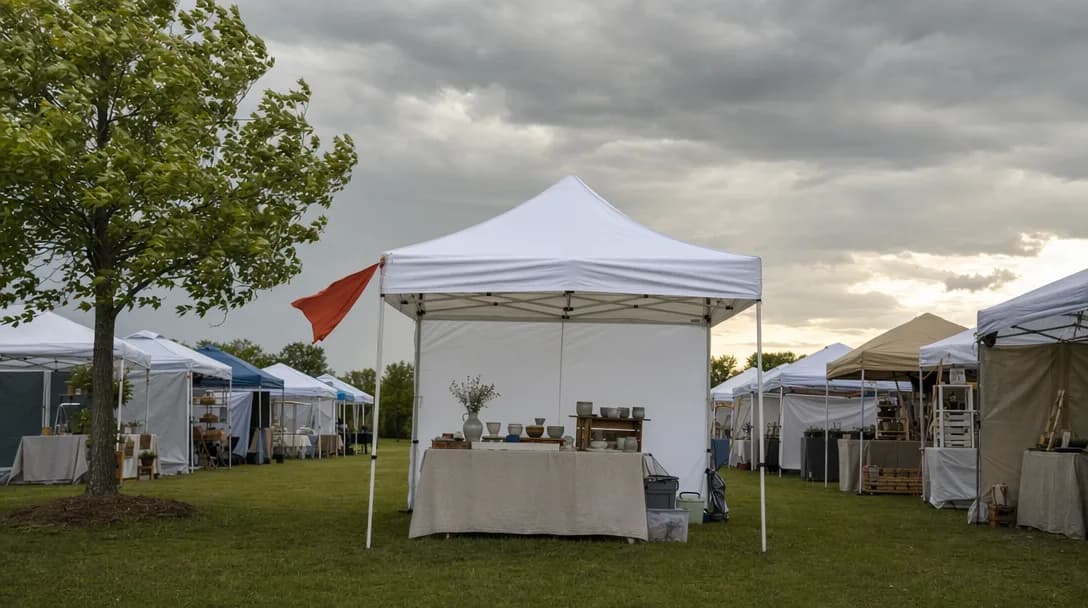
Every outdoor vendor has a story. Ours involves a perfectly sunny Saturday morning that turned into a 35-mph gust at 11 a.m. and a tent that tried to leave the lot without us. We got it down in time. The vendor two spaces over didn't.
Outdoor craft fairs are a different animal from indoor shows. The booth fee is the same, your products are the same, your hours are the same, but the physics of the day changes. Wind, rain, and sun each have their own failure modes, and each one has a fix that takes more effort to learn once than to apply every event after. This post walks through what actually matters, with the numbers and protocols we wish we'd had in year one.
Why Is Wind the Biggest Threat to an Outdoor Craft Booth?
Wind is the biggest threat to an outdoor craft booth because a pop-up canopy is essentially a large sail, and unsecured canopies can lift, collapse, or become airborne in gusts that feel mild to a person standing still. A properly secured tent handles moderate wind fine. An unsecured one doesn't need a storm to fail.
The point isn't scary. It's that wind is the one risk where the gear you bring makes the biggest single difference. The 2024 Stowe Foliage Arts Festival lost its main vendor tent to heavy wind before the gates even opened: the collapse damaged booths from roughly 80 exhibitors and forced organizers to cancel the rest of the weekend. No one was hurt. Everyone lost money. That's a wind story with a happy ending compared to how it could have gone.
Rain and sun are slower, quieter threats. Wind is the one that ends your event (or your inventory) in a single gust.
How Much Weight Do You Need on a 10x10 Canopy Tent?
The widely used standard for a 10x10 pop-up canopy is at least 40 pounds per leg, for a total of 160 pounds on the tent. In windy conditions on grass or dirt, that number climbs to 75 to 125 pounds per leg, and many farmers markets won't let you set up with less. Stake kits alone are not enough on pavement, and gallon water jugs are not enough on anything.
A quick sanity check on common weight choices: a full gallon of water is about 8 pounds, and a single brick is about 3 pounds. That's roughly 1/5 of what you need per leg, and both tend to slide or shift in a gust. Sandbags that wrap around each canopy leg, or PVC pipes filled with concrete, are the common vendor-grade answer. High Desert Farmers Market's canopy weight guide is one of the clearer public references, and it reflects what most markets enforce.
Two specific details most new vendors miss:
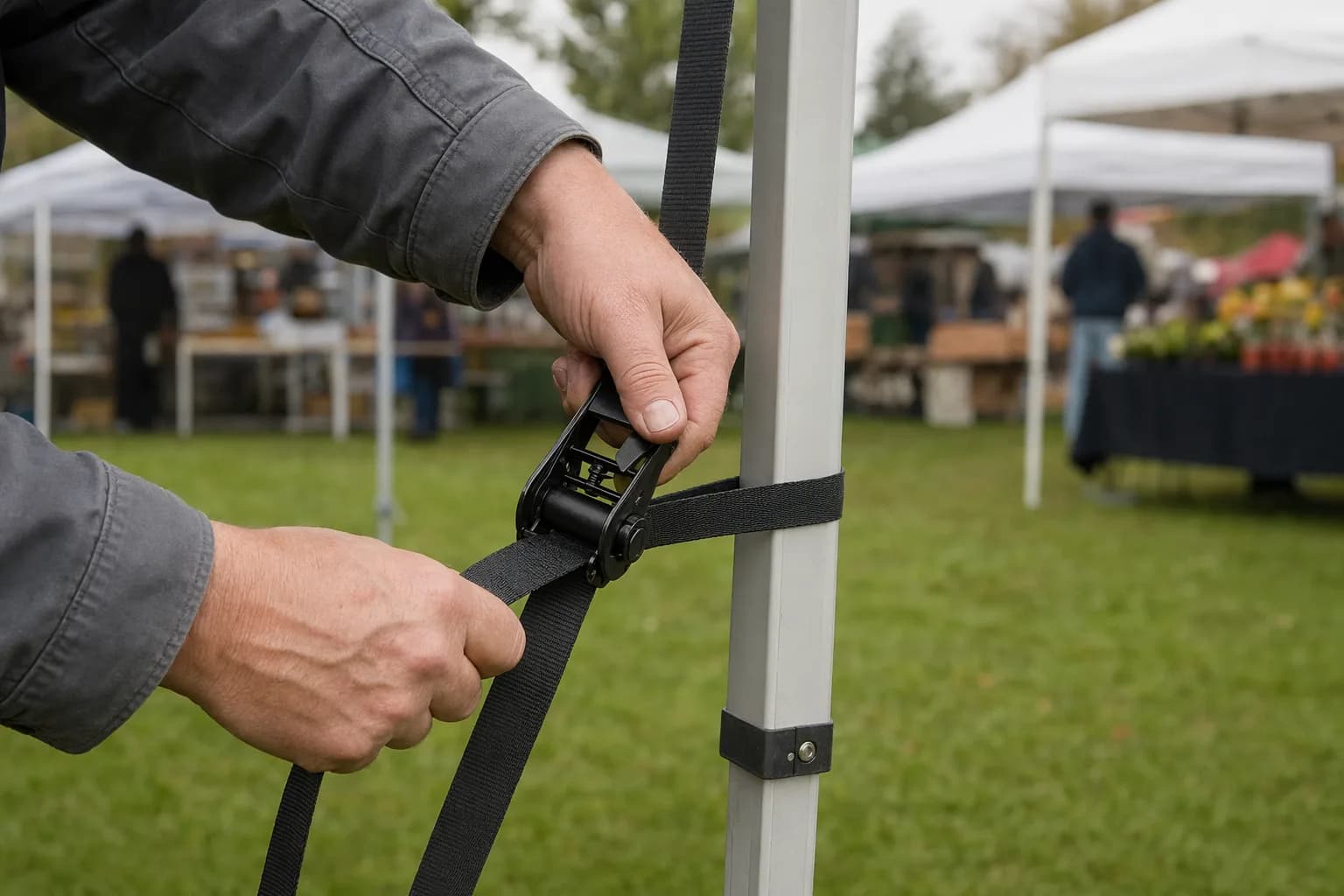
Weights should attach to the top of the frame, not the foot. If you clip sandbags to the bottom rail, a gust can still peel the canopy upward. Run the straps up to the top corner so the weight pulls the whole frame down.
Filled sand beats water. Water sloshes and shifts with wind motion. Sand, concrete, or solid plates stay put. If you're buying weights once, buy the sandbag style and fill them yourself.
Rain Plans, Not Rain Hopes
Most rain damage at outdoor events happens in the first five minutes. That's the gap between "the sky got dark" and "it's actually raining," and it's the window where people make decisions in a hurry. A written protocol beats improvisation every time.
Our short version has three steps and lives on a laminated card in the bin with the sidewalls.
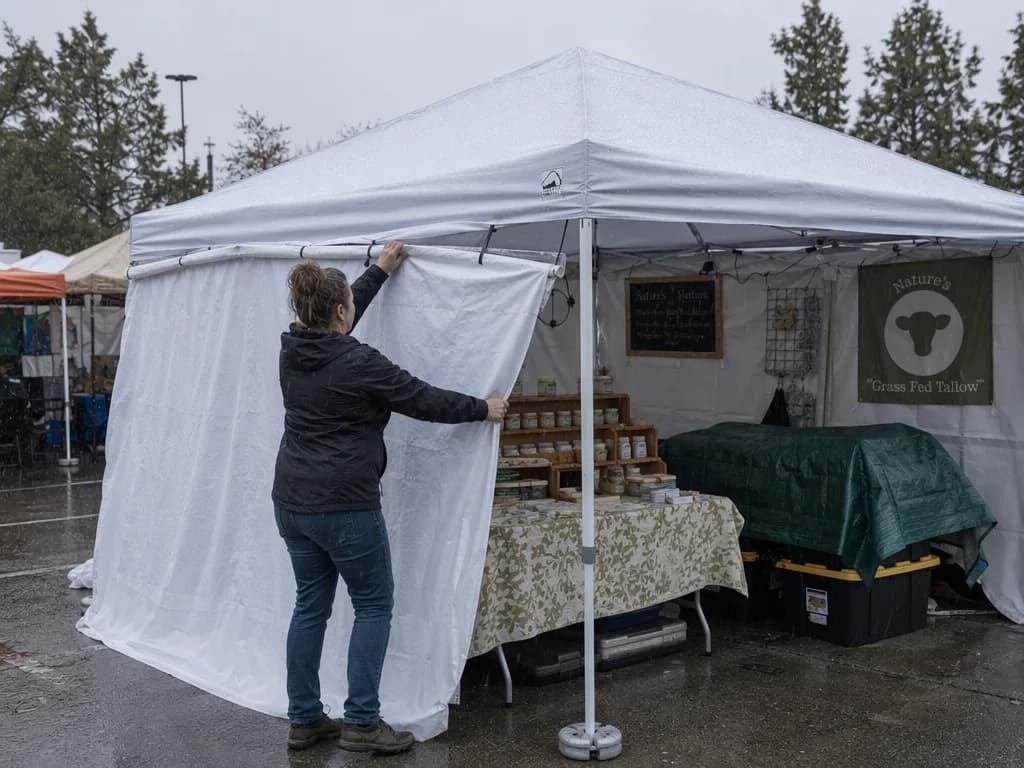
Step 1: Drop the sidewalls. Even cheap walls keep a sideways downpour off your display. If your tent didn't come with them, a basic set is usually under $75, and they pay for themselves the first time. Keep them rolled at the top corners so they deploy in under a minute.
Step 2: Cover product bins first, displayed product second. The inventory under the table is what pays for next month's events. It gets the tarp before the stuff on display does. Displayed product is visible to you, so you notice it; bin product is easy to forget.
Step 3: Decide what you abandon. Rain protocols work when you've decided in advance what you'll leave behind if things get bad. Usually that's signage, tablecloths, and anything already soaked. Don't try to save everything. Save the stuff that represents future revenue.
Practicing this once at home, with a stopwatch, takes fifteen minutes and saves an ugly afternoon.
How Does Sun Quietly Hurt an Outdoor Craft Booth?
Sun hurts an outdoor craft booth in three ways: it damages heat-sensitive product like candles and soaps, it drives shoppers away from unshaded booths during peak afternoon hours, and it wears down the vendor's stamina by the 2 p.m. slump. None of these are dramatic enough to make most vendors change gear after a single bad event, which is how they keep eating into margins year after year.
Sun doesn't blow your tent away, so it's easy to ignore. Here's where each of those three costs actually shows up.
Product damage. Candles and melt-and-pour soaps soften in direct sun once air temperature gets above their melting points, and paraffin-based candles are particularly vulnerable. Natural fabrics and dyed goods fade from UV over a season of outdoor shows even when no single event causes obvious damage. If you sell either, plan canopy placement, side panels, and a cooler with ice packs for the most vulnerable stock. (Event prep for candle and soap vendors →)
Shopper fatigue. A hot, exposed booth is a booth people walk past. Shoppers decide in seconds whether standing in your space feels okay, and direct sun at 2 p.m. usually doesn't. A canopy color that actually blocks light, one deployed side wall for western sun, and a small battery-powered fan aimed at the aisle can meaningfully change dwell time.
Your own stamina. This one sounds soft, but it's the reason sales slump between 1 and 3 p.m. at hot events. A vendor squinting, sweating, and short on water sells differently than one who isn't. Shade for you is shade for sales.
Sun gear is boring and cheap: a proper canopy with an opaque top, a white tablecloth (reflects heat), one or two reversible side panels for whichever side the sun is on, a fan, water, a hat. None of it is exciting. All of it shows up in your totals.
How Should a Vendor Read a Weather Forecast?
A vendor reads a weather forecast by looking at three numbers specifically: wind gust (not just sustained wind), precipitation timing (not just probability), and temperature peak (not the average). A 30% chance of rain at 4 p.m. means something completely different from a 30% chance at 10 a.m. when your tent is going up.
Wind is the first number to check. A tent rated for 35 mph sustained is a different tent in a 45 mph gust, and event-tent safety guidelines often recommend evacuation when sustained winds pass 36 mph or gusts last more than six seconds. Check the hourly wind gust forecast, not just the daily high. If the gust column shows anything above the mid-20s, double your weights and plan a takedown checklist for if it escalates.
Precipitation timing matters more than probability. NOAA publishes 12-hour probability-of-precipitation forecasts, but the hourly view on any good weather app tells you what you actually need, which is when. A 60% chance from 3 to 6 p.m. (as the show ends) is very different from a 60% chance from 9 to noon (right when you're setting up). Plan your setup and teardown windows around the dry windows if there are any.
Temperature peak tells you what your candles and your customers will do. If the peak hits 95° between 1 and 3 p.m., that's when you lose both product integrity and foot traffic, and that's the window where shade and airflow earn back their cost.
When Is It Okay to No-Show a Craft Fair?
It's okay to no-show a craft fair when the forecast risk outweighs the cost of the booth fee, which is usually when a ruined canopy, damaged product, or a wasted drive would cost more than the deposit you'd forfeit. Most fees run $50 to $200. Worst-case exposure often runs $500 to $1,000 or more. The math is simpler than it feels in the moment. A booth fee evaluator can help frame that tradeoff numerically if you're unsure.
We've had plenty of "iffy" forecasts that turned into fine days, and no-showing too often builds a reputation with organizers that's hard to repair. The rule we've landed on: for one-day shows, we go unless the forecast shows sustained winds above 25 mph, gusts above 35 mph, or heavy rain for more than half the event window. For multi-day shows, we set up and play day two by ear.
If you do no-show, email the organizer the night before. They'd much rather know than wonder.
The Event-Day Reliability Stack
Outdoor events punish anyone whose plan lives on a single phone with no signal. Fairgrounds are notoriously bad for cell service, and the moment you need to check the radar is usually the moment you discover you can't.
We built MyEventPrep partly around this. Every event detail page has a five-day forecast attached to it, so wind and rain numbers sit next to the checklist and the product plan instead of in a separate app. After the event, you record the actual weather along with your sales totals from Square and a short notes field, and that record carries forward to next year's version of the same event. A year later, when the same market rolls around, your notes tell you that "the Foxwood fair is always 15° hotter than forecast and the west side catches wind after noon." That's the kind of specific, local information you can't Google.
And because the app works offline, the data you need at 10 a.m. on an event day is already on your phone before you leave the house.
Why a Post-Event Weather Log Pays Off in Year Two
A post-event weather log pays off in year two because outdoor events are local, and local weather patterns repeat. The first time you do an event, you're packing for "an outdoor market in July." The second time, you're packing for that event, with that microclimate, at that time of day. The second version is a much better packing list.
One line in your notes (peak temp, wind direction at noon, whether the rain materialized, what you wish you'd brought) is enough. A year later you'll re-read it before you pack, and every trip to an outdoor event starts getting a little easier.
That's the whole idea. The second event is easier than the first, not because outdoor fairs get easier, but because your notes get smarter.
Ready to stop relying on memory? Track weather actuals across every event with a free MyEventPrep account. Every event you log makes the next one simpler to pack for.
Frequently asked questions
How much weight do I need on a 10x10 craft fair tent?
A widely used standard is at least 40 pounds per leg, or 160 pounds total for a 10x10 canopy. In windy conditions or on grass, many markets require 75 to 100 pounds per leg. Gallon water jugs weigh about 8 pounds each and are not enough. Sandbags that wrap each leg, or PVC filled with concrete, are the typical vendor-grade choice.
What should I do if it starts raining mid-event?
Run a three-step protocol: drop your sidewalls, cover your product bins before your display, then triage the rest by value. Anything fabric or paper gets moved under cover first. Anything already soaked can wait. Deciding these priorities in advance (and practicing the protocol once at home) turns a five-minute panic into a calm two-minute task.
At what wind speed should I take down my canopy?
Event-tent safety guidance commonly recommends evacuating or taking down pop-up canopies when sustained winds pass 30 to 36 mph, or when gusts last more than six seconds. Many experienced vendors start packing up earlier if gusts approach that range. Check the hourly gust forecast, not just the daily average, because gusts do more damage than steady wind.
How do I protect candles and soap from sun at outdoor fairs?
Set your canopy so the sun never hits the display directly, deploy a side panel on the western-facing side after noon, and keep the most heat-sensitive product in a cooler with ice packs until it's needed. Paraffin candles and melt-and-pour soaps soften fastest. Soy wax and cold-process soaps are more forgiving, but none of them love 95° asphalt.
Is a craft fair booth fee refundable if the weather is bad?
It depends on the event. Most craft fairs and farmers markets are explicit in their applications that booth fees are non-refundable regardless of weather, though a few will offer a credit toward a future event. Read the application before you sign. When in doubt, ask the organizer directly, and weigh the fee against the worst-case cost of damaged gear or product.