What to bring to your first market: the short list

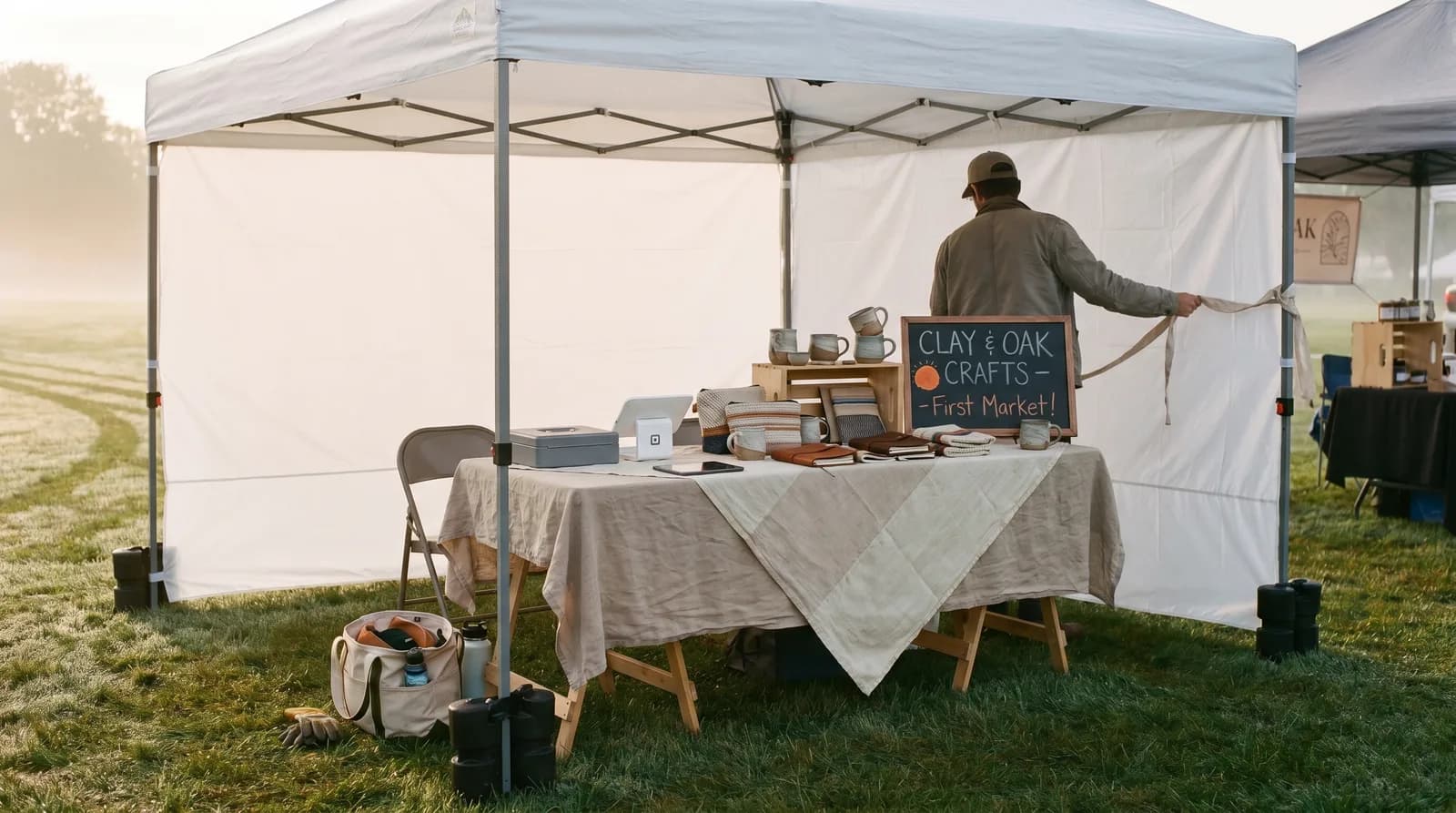
The week before a first market is usually a slow build of low-grade panic. You make a list, add to it, scroll through Instagram for ideas, add more, and end up with a spreadsheet of forty-seven items that won't fit in the car. We've all been there. The instinct to overpack is real, and it's mostly fine — but a calmer way to do this is to separate the non-negotiables (you can't sell without these) from everything else (nice to have, can add later).
Here's the focused version of the list. The full, categorized version lives in our complete craft fair packing checklist when you want it. This page is for getting through the first one without a 6am garage spiral.
In this guide:
- What does a first market booth actually need?
- The seven things you can't sell without
- What's worth skipping (or borrowing) the first time
- The small stuff first-timers most often forget
- How experienced vendors stop forgetting things
- A short night-before routine
What does a first market booth actually need?
A booth needs three things to function: a place for the products to live, a way for customers to see them, and a way to take money. Everything else makes the day smoother, but those three are the floor.
That sounds obvious, but it's worth saying out loud because most overpacking happens after the floor is covered. You add a third tablecloth because the first one might not match. You bring two banners because you can't decide. By 6am you're loading items into the car that won't matter at all on the day. Resist this. A clean, simple booth set up well reads as more professional than a busy booth set up in a hurry.
The seven things you can't sell without
Miss any of these and you either can't open or can't transact. Pack them first.
- A canopy with weights — if you're outdoors. 10x10 is standard. Weights are usually required (one per leg, 25 to 40 lbs each). Many organizers will send you home without them.
- A folding table sized to your booth footprint, with a tablecloth long enough to hide the bins underneath.
- Your products, packed in a way you can restock from without tearing the booth apart.
- Clear price tags on everything, or visible signs by each product tier.
- A cash float — small bills and coins. About $100 total is plenty for most first events.
- A card reader (Square or similar) and a charged phone or tablet to run it.
- A banner or sign with your business name, big enough to read from twenty feet away.
That's the booth. Once those are loaded, you have a functioning operation. Everything else from here is comfort, polish, or insurance against bad luck.
What's worth skipping (or borrowing) the first time
A few things almost every first-time-market post recommends that you don't actually need on day one:
| Often recommended for a first market | What's actually fine to skip |
|---|---|
| A second backup table | One sized correctly handles a small first booth. Add later if you grow into it. |
| Branded everything (bags, ribbon, stickers) | Plain paper bags or a stack of small kraft bags work for event one. Brand them when the line is settled. |
| A full lighting rig | Outdoor daytime markets don't need it. Indoor venues usually have house lighting that's good enough for one event. |
| Multiple banners and signs | One clear banner with your business name is enough. A second sign is fine but optional. |
If you have a vendor friend, ask before you buy. A spare set of canopy weights, an extra tablecloth, or a folding chair that lives in someone's garage is easier to borrow than buy. Most vendors will lend things for a first market — the community is friendlier than it looks.
The small stuff first-timers most often forget
The items that don't ruin your day but make you mutter under your breath:
- A pen (you'll need it for receipts, raffles, exchanging info with a customer)
- Scissors and packing tape
- A few zip ties
- A roll of paper towels and a rag
- Trash bags (two large ones)
- Hand sanitizer
- A backup phone charging cable
- A small box of band-aids
- Sunscreen and a hat if outdoors
None of these are required to make the booth work. All of them are required to make the day not slowly grate on you. A small "market kit" containing all of these — pre-packed and lived in a bin in the car — is what experienced vendors carry without thinking. Building that bin is something you can do over the first three or four events; you don't need it perfect on day one.
How experienced vendors stop forgetting things
The pattern that solves this isn't a longer checklist. It's a system that lives in your car between events.
The short version: pre-packed bins that stay packed, restocked for fifteen minutes after each event instead of unpacked into the house and re-gathered the night before the next one. We walk through it in detail in the never-unpack-the-bin craft fair system. The first market is too soon to build the whole thing — but it's a useful read when you're sitting in the parking lot after the event thinking "next time, what would I change?"
A short night-before routine
The morning of your first market is not the time for decisions. Do them tonight.
- Pack the car, not the kitchen. Everything that's coming with you goes in the car the night before.
- Check the seven non-negotiables. Touch each one. Canopy, table, products, tags, cash, card reader, banner. If you can physically point at all seven in the car, you're ready.
- Charge the phone and card reader. Cable goes in the front seat for the drive.
- Set the alarm 30 minutes earlier than you think you need. Setup always takes longer than expected. Especially the first time.
- Put the cash box somewhere you cannot leave without it — on top of your keys, against the front door, on the driver's seat.
- Write down one thing you want to learn at this event. Not "make a lot of sales." Something small — like "what people look at first," or "how many ask about a specific product."
The first market is rarely the right read on your business. It's a first reading on what you wish you'd brought, how long setup actually takes, and how a real customer reacts to a real booth. That information makes the second market noticeably calmer.
If you'd like a place to keep the lessons (and your packing list, and your numbers) between events, MyEventPrep is built for exactly that. Sign up free at myeventprep.app/signup during early access — no credit card needed.
Frequently Asked Questions
What's the bare minimum I need to bring to my first craft fair?
A canopy with weights (if outdoors), one folding table, a tablecloth, your products, clear price tags, a way to take money (cash float plus a card reader), and a banner or sign with your business name. Everything else can be added at the next event. A bare-bones booth set up well looks better than an overstuffed booth set up in a panic.
Do I need a canopy at my first market?
If it's outdoors, yes — and you need weights, one per leg, usually 25 to 40 pounds each. Many markets won't let you set up without them. Even on clear days, wind can lift an unweighted canopy and damage your booth or a neighbor's. If you're indoors, you can skip the canopy entirely.
How much cash should I bring to my first craft fair?
A starting float of around $100 in small bills handles most events — roughly 4 to 6 fives, a stack of ones, and a roll or two of quarters. The bigger risk is running out of small bills early, not running out of cash overall. Bring a card reader too; many customers won't carry enough cash for anything over $20.
Should I bring all my inventory to my first market?
No — you'll probably overestimate. For a smaller first event, plan based on expected foot traffic and a realistic conversion rate, and leave room in the car for what you actually need. Our guide to how many of each product to make walks through the math.
What's the most common thing first-time vendors forget?
Change for a $20. The cash float runs out of singles or fives in the first hour and you find yourself begging the neighboring vendor or sending a customer to the ATM. Right behind that: a pen, scissors, and tape. The small stuff that you assume will "be in the car somewhere" usually isn't.