How to Price Handmade Jewelry Without Guessing

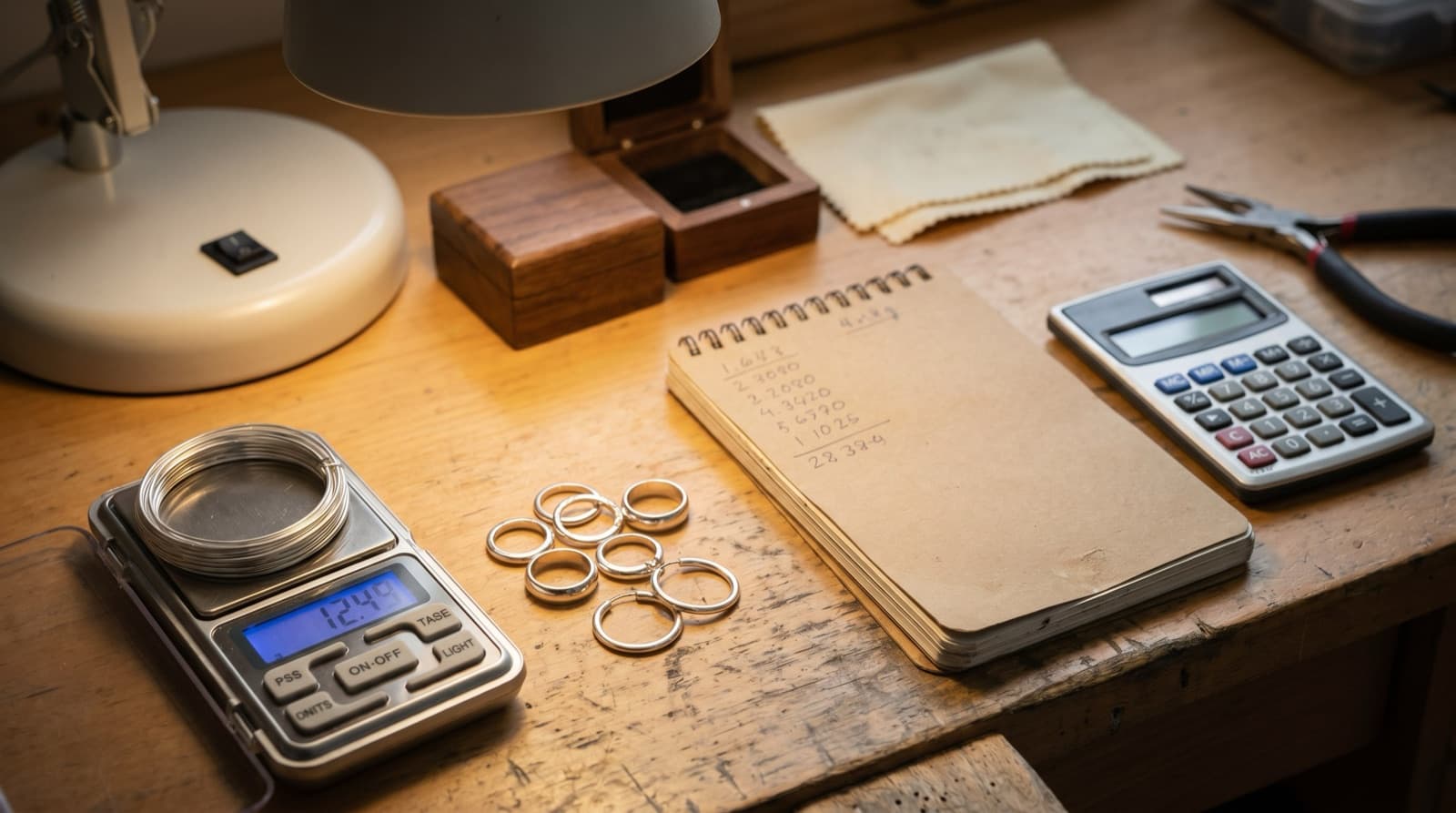
If you want to know how to price handmade jewelry, skip "charge what you're worth." That advice feels nice and tells you nothing. A real price comes from a number you can build: what the piece costs you to make, plus your time, plus the slice of your business costs it should carry, plus profit. Do that, and the number stops feeling arbitrary.
This matters more for jewelry than almost any other handmade category. Your pieces are small, your material costs swing with metal prices, and you might have 200 SKUs across a few finishes. It is easy to lose money on a piece that "feels" priced right because you never counted the clasp, the polishing time, or the booth fee.
Here is the method makers actually use, with the parts most people skip. We will build the formula, run a real example, and then handle what changes when you sell in person versus online.
How do you price handmade jewelry?
Start from true cost, then add margin. The formula is: materials, plus labor, plus overhead, divided by (1 minus your target margin). Materials means every component in the piece. Labor means your time at an hourly rate. Overhead means a share of the costs you pay no matter what. The result is your minimum retail price, the floor you cannot go below without losing money.
That is the same backbone the established jewelry guides teach. Craftybase frames it as materials cost plus labor cost plus overhead plus profit margin equals retail price. The long-running Jewelry Making Journal uses a slightly different shape, materials and packaging times 4, plus labor, plus 10 percent overhead, built so you still profit if you ever sell wholesale. Different math, same goal: a price that covers everything.
The mistake is pricing on materials alone. If a pair of earrings uses $4 of supplies and you charge $8, that feels like "doubling your cost." It is also a loss, because your time and your overhead were never in the number. Let's count them properly.
Step 1: Count every material, down to the clasp
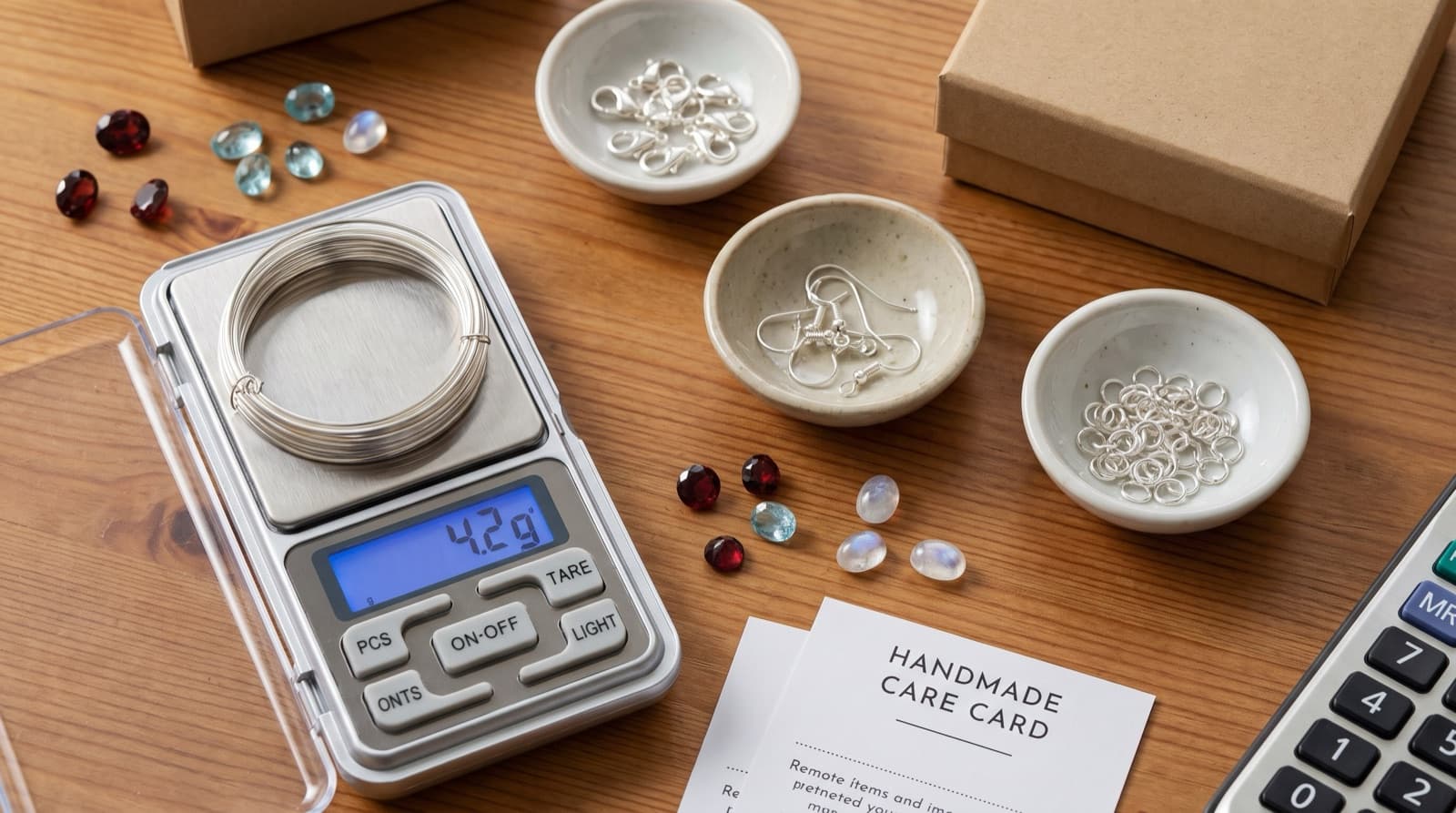
Materials cost is every component that ends up in or on the finished piece. For jewelry, that is more line items than it looks. Skipping the small ones is the quiet way makers underprice.
- Metal by weight. Sterling, gold-fill, brass, and copper are bought by the gram. Work out your cost per gram (purchase price divided by grams), then multiply by the grams in the piece. Craftybase's example: 20g of sterling sheet for $18.60 is $0.93 per gram, so a 3.2g band is about $2.98 in silver alone.
- Findings per unit. Clasps, jump rings, ear wires, head pins. Bought in packs, used by the piece. A bag of 100 ear hooks at $12 is $0.12 each, so $0.24 for a pair.
- Stones, wire, and chain. Gemstones per stone, wire by the inch or foot (gauge matters), chain by the inch.
- Packaging. The box, tissue, card, and bag. A $0.85 box left out of the price is $0.85 of margin gone on every sale.
A useful habit: total your honest materials estimate, then add about 15 percent, because you almost always miss something small.
Step 2: How do you factor your time into the price?
Pay yourself an hourly rate, then multiply by the minutes each piece takes. The formula is simple: minutes divided by 60, times your hourly rate. A piece that takes 45 minutes at $30 an hour carries $22.50 in labor. That number often shocks makers, and that is the point. If your time was not in the price before, you were giving away your skill for free.
There is no single correct rate. Common starting points run $20 to $30 an hour for a part-time solo maker, and up to $45 to $65 for advanced bench work. The wrong rate is $0.
Time yourself honestly, across a few sessions, and include everything: cutting, forming, soldering, stone setting, polishing, photographing, and packing. Your best-day speed is not your real average. This is the single most-skipped step, and it is why a busy craft fair day can still fail to pay. Pricing for your first craft fair walks through the same labor trap with more examples.
Step 3: Add the overhead most makers forget
Overhead is every business cost that is not a specific material or a direct labor hour. You pay it whether you make one piece or a hundred, so each piece should carry a share.
For a jewelry business, that list is long: studio or bench space, tool replacement (burs, wheels, torches wear out), photography gear, platform and listing fees, card processing, insurance, marketing, and bookkeeping. The simplest way to spread it is monthly: add up your monthly overhead, then divide by the pieces you realistically make and sell that month.
Craftybase's example puts $380 of monthly overhead across 45 pieces, about $8.44 per piece. The uncomfortable part: in a slow month, the same overhead spread over fewer sales costs more per piece. That is exactly why underpricing hurts most when sales are already thin.
Markup or margin: what should you actually charge?
Markup and margin are not the same thing, and confusing them is how makers think they are profitable when they are not. Markup is added on top of cost. Margin is profit as a share of the selling price. A 50 percent markup on a $20 cost gives $30, but that $30 price is only a 33 percent margin.
When makers say "I price at 2.5x," they mean a markup multiple, which is fine for quick estimates. For real planning, aim at a margin. Craftybase suggests a healthy retail margin of about 25 to 40 percent after all costs, with wholesale typically at 50 percent of retail.
| Approach | The math | Best for |
|---|---|---|
| Markup multiple (2.5x to 3x cost) | Total cost x 2.5 to 3 | Fast estimates, simple lines |
| Margin target (25 to 40 percent) | Total cost divided by (1 minus margin) | Planning, mixed channels |
| Keystone / x4 materials | (Materials + packaging) x 4, plus labor, plus 10 percent | Makers who also sell wholesale |
Whatever method you pick, sanity-check the result against your floor. If the number lands below materials plus labor plus overhead, it is not a price, it is a donation.
A worked example: pricing a sterling silver ring
Numbers make this real. Here is Craftybase's worked example for a hammered sterling band with a 6mm labradorite cabochon, the kind of piece a lot of makers sell at fairs.
The true cost adds up like this:
| Cost piece | Amount |
|---|---|
| Materials (silver, bezel, stone, solder, packaging) | $7.30 |
| Labor (65 minutes at $30/hr) | $32.50 |
| Overhead ($380/month over 45 pieces) | $8.44 |
| True cost | $48.24 |
At a 35 percent margin, the retail price is $48.24 divided by 0.65, which comes to about $74. Now compare that to what happens if you price the ring by guessing from similar listings.
| Priced by guessing (match Etsy) | Priced from true cost |
|---|---|
| Glance at similar rings, land on $45 | Add materials + labor + overhead = $48.24 |
| Feels competitive and safe | Apply a 35% margin: $48.24 / 0.65 |
| Price: $45 | Price: about $74 |
| Loses roughly $3 per ring before any fees | Covers costs with real profit left over |
| Busy days still don't pay | Each sale actually moves you forward |
That gap is the whole article in one table. The $45 ring loses about $3 before Etsy's fee takes another few dollars. The $74 ring pays you. If $74 feels too high for your crowd, that is useful information too: it means trimming overhead, speeding up the build, or rethinking the piece, not quietly eating the loss. The per-piece math is yours to run, but once your prices are set, the free show profit calculator totals a market's revenue against your booth fee, materials, and expenses, so you can see whether the whole day actually paid.
Should your craft fair price match your Etsy price?
Usually the two land close, but they get there by different paths, so do not just copy one to the other. On Etsy you pay 6.5 percent per sale, 3 percent plus $0.25 in processing, and $0.20 per listing, which works out to roughly 20 to 25 percent of each sale once everything is counted. At a booth those fees vanish, replaced by the booth fee, card processing, gas, and your time.
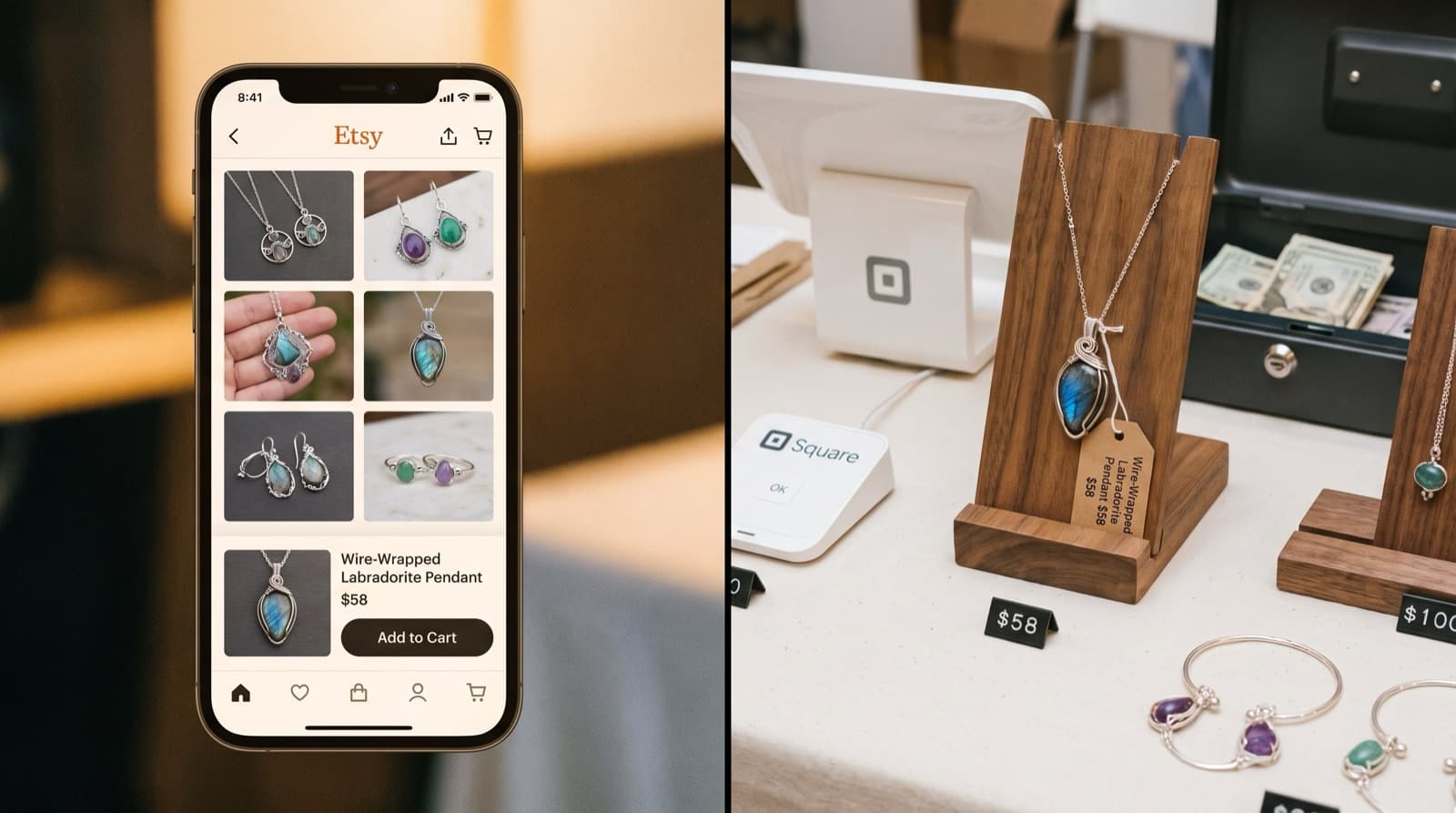
The trap is "Etsy price minus fees." That 20 percent was not free money, it paid for Etsy, and the booth needs the same cushion for its own bills. A $200 booth fee spread across 50 expected sales adds $4 to every item's true cost before you sell a thing.
In-person buyers do give you more room, though. One study found 40 percent of in-person shoppers spend more than planned, compared with 25 percent online. At a table you can hold the piece, tell its story, and use an anchor piece to make the rest feel reasonable. For the full breakdown of how the numbers shift, see what changes when you bring your Etsy prices to a craft fair, and run the day's math first with the booth fee evaluator.
How do you know your prices are working?
Track 3 numbers per event and compare them over time: profit margin after costs, revenue per hour, and sell-through (the share of what you brought that actually sold). Prices that look fine on a spreadsheet sometimes underperform at a real table, and the only way to catch it is to measure. A piece that earns well per hour deserves more inventory. One that does not is data, not failure.
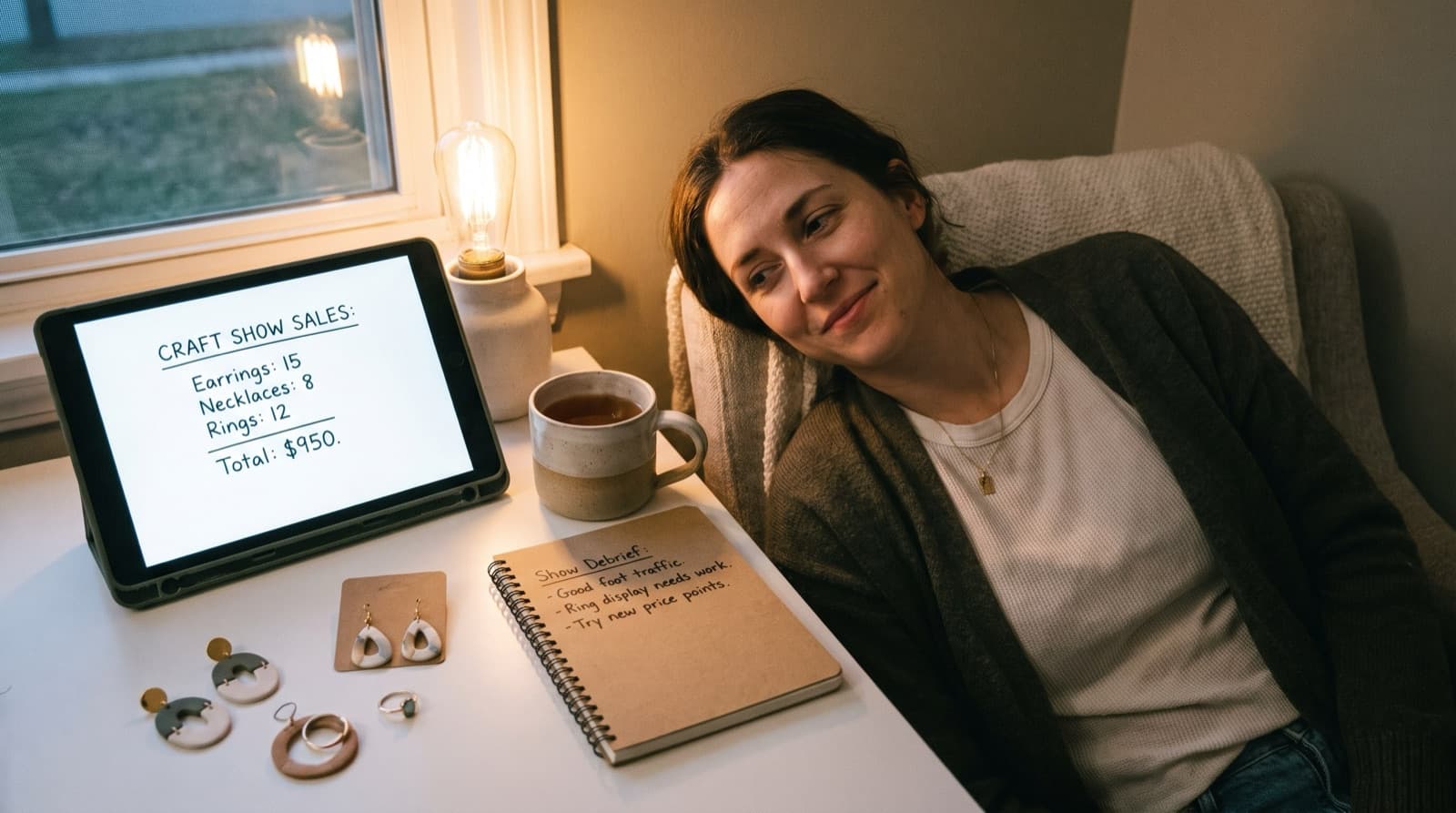
A 5-minute post-event debrief captures most of it while the day is fresh: what sold out, what sat, what people picked up and put back. Do it a few times and the patterns turn into pricing decisions. This is the part most makers skip. Setting a price is easy. Knowing whether it worked is what makes the next show better.
That is the idea behind MyEventPrep's jewelry tools: your per-piece sales come back from each event, so the next price you set is backed by what your own crowd actually paid.
The point
Pricing handmade jewelry is not about confidence, it is about counting. Materials down to the clasp, your time at a real rate, a fair share of overhead, then margin on top. That gives you a floor, and the floor takes the guessing out of every piece that follows.
From there, the venue and the crowd fine-tune the number, not your nerves at midnight before a show. Price your pieces from true cost, then let the free show profit calculator tell you whether a market actually paid once the booth fee and costs are in, and start a free MyEventPrep account to track which pieces actually pay, show after show.