How to collect customer emails at a craft fair (and actually use the list after)

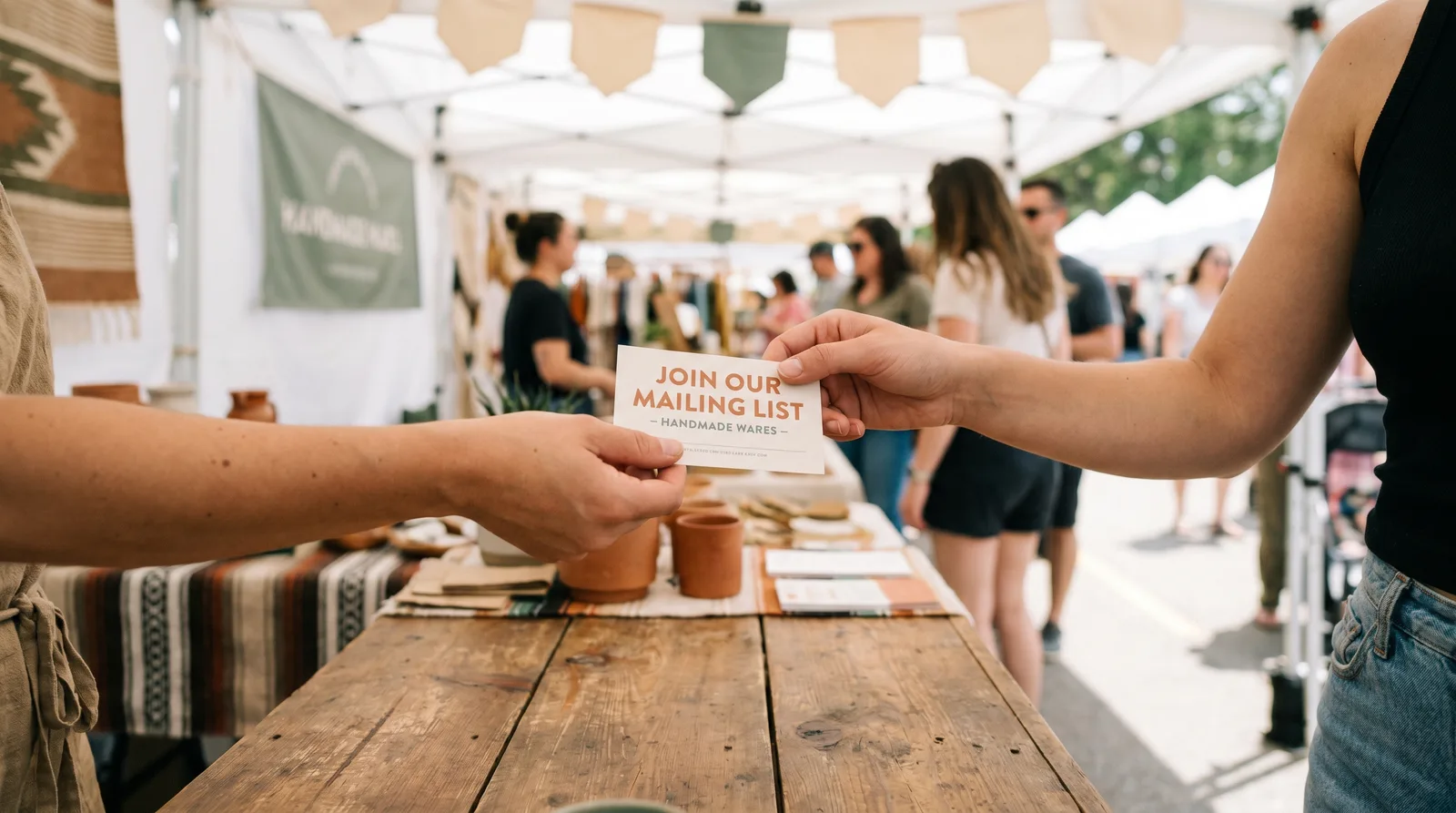
Most vendors leave a craft fair with cash in the till and zero way to reach the people who just bought from them. Then they spend the next month chasing new shows instead of mining the buyers they already converted. Learning how to collect customer emails at a craft fair is the most useful thing you can do at a booth that isn't actually selling.
The trick isn't a fancy form or a perfect signup line. It's having a plan for what you'll ask, what you'll offer, and what you'll send 2 days later. That plan compounds. A buyer this Saturday becomes a custom order in November, and a referral the following spring. None of it happens if you don't have their email.
This guide walks through what to ask for, how to ask without breaking the conversation, and what to do with the list once you have it.
Why bother collecting customer info at a craft fair?
Because the list compounds. A buyer at one market becomes a custom order a few months later, and that's where the real money is. Email marketing returns $36 to $45 for every dollar spent across retail and e-commerce, which is a higher return than basically any other channel a small maker has access to.
Here's what that looks like for us. Over the years, just from staying in touch with past buyers, we've landed a $200 custom birthday party order and a handful of smaller custom orders along the way. None of those came right after a single email or a single fair. They came because the list existed, and we kept showing up in it.
The booth is the only place you'll meet a stranger who is already holding your product, has already paid for it, and is in a good mood. That's the warmest audience you'll ever get. Sending them home without a way to find you again is the most expensive mistake on the table.
Email, phone, or social: which one should you actually ask for?
Lead with email. It has the lowest opt-in friction, you own the list outright, and the math works. Phone numbers convert higher per send but ask more of the customer. Social follows feel easy and produce nothing reliable.
Here's the trade-off in plain terms. Email open rates run around 37%, and a good handmade vendor list does better than that. SMS gets 98% open rates and is read within 3 minutes, which is impressive, but asking for a phone number at a booth is a different conversation. Most buyers will hand over an email without thinking. A phone number takes a second to weigh.
Social media follows are the worst trade of the three. The platform owns the audience, the algorithm decides who sees what, and you can lose half the reach in a quiet week. If someone wants to follow you on Instagram, great. Get their email too.
Our recommendation: ask for email as the default. If you want phone numbers, make them optional on the same form. Treat social as a bonus.
3 capture methods that actually work at a booth
There are 3 setups that consistently work. Pick the one that fits your temperament and your booth, not the fanciest option.
A paper signup card with a clipboard. Cheapest, lowest tech, surprisingly effective. A clipboard means people don't have to clear space on your table to write. Made Urban argues that list-building should be your number-one priority at shows, and the paper method is the easiest way to start. Downside: you type everything in later, and handwriting can be rough.
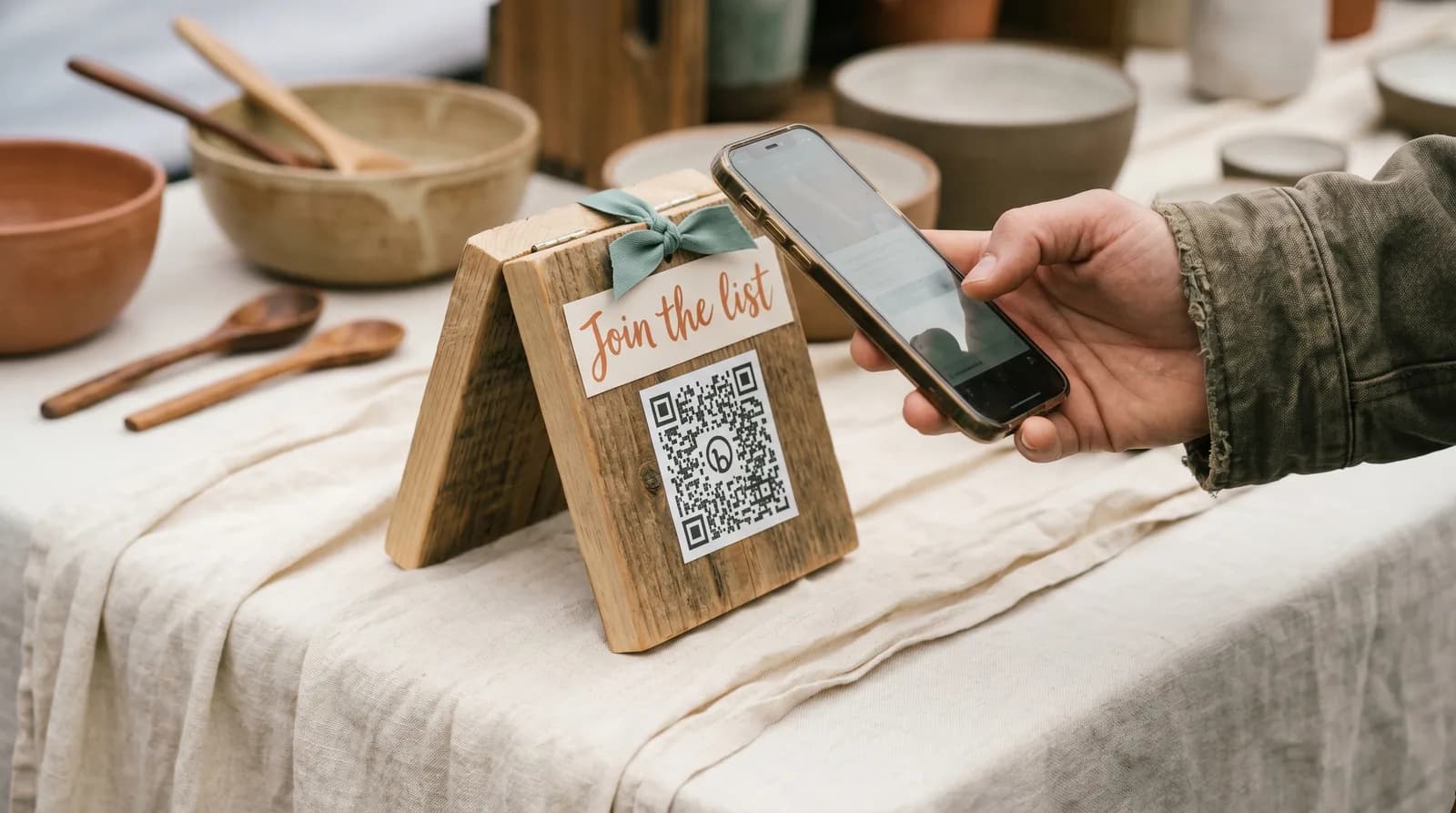
A QR code on a small sign. A QR code on a tabletop sign sends people straight to a signup form on their phone. It's clean, it scales, and it doesn't take any of your time during a busy rush. Downside: people have to want to scan it, which means the sign and the offer have to do the work.
A tablet or phone with a form open. Best conversion if you already use a tablet for Square. Hand it across the table after a sale and the buyer fills it out themselves. Downside: it's another piece of gear, and if your tablet is busy running checkout, this doesn't work.
If you've never collected emails before, start with the paper card. You can graduate to a QR code or tablet once you know what you want the form to ask.
What to offer in exchange (without giving away the margin)
The signup is a trade. They give you an email, you give them something. The framing of what you give matters more than the dollar value.
The 4 offers that work best:
A raffle entry for a piece of your own work. This wins for handmade vendors because the prize feels personal and the cost to you is low. One item, one drawing, one new list of subscribers. People who'd never sign up for a discount will sign up to win a thing they just admired.
10% off their next purchase. Effective but cheaper-feeling. Works if you also have an online shop. Pairs well with a "your code arrives in your inbox in a few minutes" line that justifies the email ask.
Early access to new releases or drops. Costs you nothing. Works best if you actually do drops or seasonal collections. Frames the list as a VIP thing instead of a marketing thing.
A small free guide tied to the craft. "5 ways to care for handmade ceramics," for example. Costs you one afternoon to make, and signals expertise.
What to avoid: vague "join our newsletter" with no offer. Almost no one signs up for a newsletter. They sign up for a thing.
How soon should you email after a craft fair?
Within 24 to 48 hours. Businesses that follow up in that window see roughly 25% higher response rates than those who wait a week. The buyer's bag is still on the kitchen counter. They remember you. The longer you wait, the more they don't.
The first email doesn't need to be a masterpiece. It needs to land while the memory of your booth is still warm. A 3-sentence thank-you, a photo of a product they might have liked, and a link to your shop is enough. Send it Monday morning if the fair was on the weekend.
If you can't write the email in the moment, write it before the fair. Pre-draft it Friday night, send it Monday. The work is done before you're tired.
The follow-up sequence that turns a fair into months of revenue
3 emails over about 3 weeks. That's the whole sequence. It's simple on purpose.
Email 1, within 48 hours of the fair: thank you for stopping by, here's the product you might have been eyeing, link to the shop. Keep it short. People recognize they were at your booth and they appreciate being remembered.
Email 2, about 7 days later: a story or a behind-the-scenes look. How a piece gets made, a sourcing decision you wrestled with, the favorite thing you sold that weekend. This is the email that builds the relationship.
Email 3, 2 to 3 weeks later: where you'll be next, and what's new in the shop. Soft sell. Mention upcoming markets, online drops, anything they can choose to act on.
A note on custom orders: requests like the $200 birthday party one almost never come from a coupon email. They come from emails that show personality. The story emails do more for custom-order revenue than the discount emails ever will.
If this feels like a lot, build it into your post-event debrief so the writing happens once and the sequence runs itself on every fair after.
How to know if your capture is actually working
3 numbers to watch, all of them quiet.
Signups per event. Set a target. 1 signup per hour at the booth is a fine starting line. If you're hitting that, your offer and your sign are doing their job.
Signup-to-buyer conversion. Of the people who signed up at a fair, how many bought something from you in the next 6 months? This one is hard to track by hand. It's the place where logging sales by event starts to compound, which is part of why we track booth conversion rate as a core metric.
Repeat-buyer rate, event over event. The number of people buying from you this year who also bought from you last year. If you sell through Square, their built-in Customer Directory tracks this automatically. This is the metric that proves the list is real.
If you skip this part, the list still helps, but you'll feel busy without knowing if you're compounding anything. Measuring is the difference between marketing as a habit and marketing as a feeling.
Three things to take away. Capture is more valuable than the average sale, because the average sale ends when the customer leaves the booth. The follow-up is what makes the capture real, and the follow-up isn't complicated. And the payoff is rarely on a tidy timeline. The $200 custom order doesn't arrive the Monday after the fair. It arrives 4 months later, from someone you'd almost forgotten about, because the list was there.
If you'd like to log what sold at every fair so the next one gets smarter, that's what MyEventPrep is built for. Sign up free and let one fair start feeding the next.
Frequently asked questions
What's the best way to collect emails at a craft fair? Start with a paper signup card and a clipboard, paired with an incentive like a raffle entry for one of your handmade pieces. It's the lowest-friction method and works for any booth size. Move to a QR code or tablet form once you know what you want the form to ask.
Should I use a QR code or a paper signup sheet? Both work. Paper is faster for buyers who are mid-conversation and don't want to pull out their phone. QR codes save you the data entry work afterward. If you're new to email collection, start with paper, then add a QR code on a sign for buyers who prefer to scan.
How fast do I need to follow up after a craft fair? Within 24 to 48 hours. Businesses that follow up in that window see meaningfully higher response rates than those who wait a week or more. Pre-draft the first email before the fair if you know you'll be tired afterward.
What should I offer to get people to sign up at my booth? For handmade vendors, a raffle entry for one of your own pieces tends to outperform a generic discount code. Early access to new releases also works well. Avoid vague "join our newsletter" framing. People sign up for a thing, not a list.
Do I need to worry about spam laws like CAN-SPAM when emailing craft fair customers? Yes, even for a small list. Every marketing email needs a working unsubscribe link and your business mailing address in the footer. Most email tools handle this automatically, so the practical step is using a real email tool (Mailchimp, Flodesk, ConvertKit, and similar) instead of sending from your personal Gmail.